As sports betting becomes increasingly data-driven, more bettors rely on models, algorithms, and statistical systems to gain an edge. However, one of the most common and dangerous mistakes in betting analytics is overfitting.
Overfitting causes betting models to look incredibly accurate in historical testing but fail badly when real money is on the line. Understanding this concept is essential for anyone using data, AI, or predictive tools to bet smarter.
What Is Overfitting?
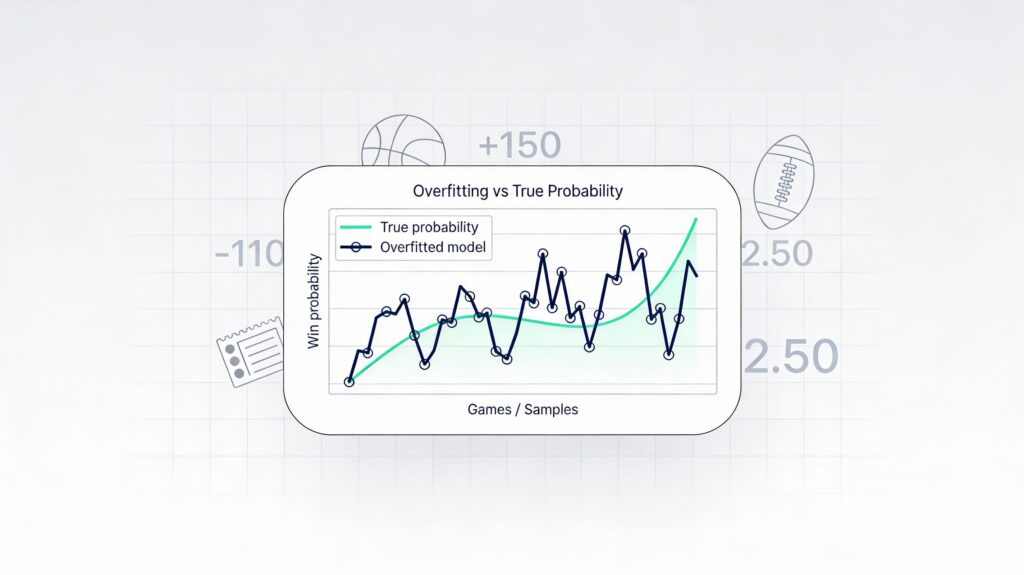
Overfitting happens when a betting model is trained too closely on past data, capturing random noise instead of real, repeatable patterns.
An overfitted model:
- Performs exceptionally well on historical data
- Fails to predict future outcomes accurately
- Confuses coincidence with causation
In simple terms, the model memorizes history instead of learning how the game actually works.
A Simple Betting Example
Suppose you build an NBA betting model using 30 different variables. Some of them are meaningful (team efficiency, injuries), while others are irrelevant (day of the week, jersey color).
The model shows an impressive win rate in backtesting. But once used in live betting, performance drops sharply.
This happens because the model relied on patterns that existed only by chance in the historical dataset. That’s classic overfitting.
Why Overfitting Is Dangerous for Bettors
1. False Confidence
Overfitted models create an illusion of edge, encouraging bettors to trust results that won’t repeat.
2. Poor Live Performance
When new data arrives, the model collapses because it never learned true predictive relationships.
3. Increased Risk Exposure
Bettors often increase bet size due to high confidence, magnifying losses.
4. Long-Term Failure
Unlike variance, overfitting leads to systematic losses over time, not temporary swings.
Overfitting vs Sample Size
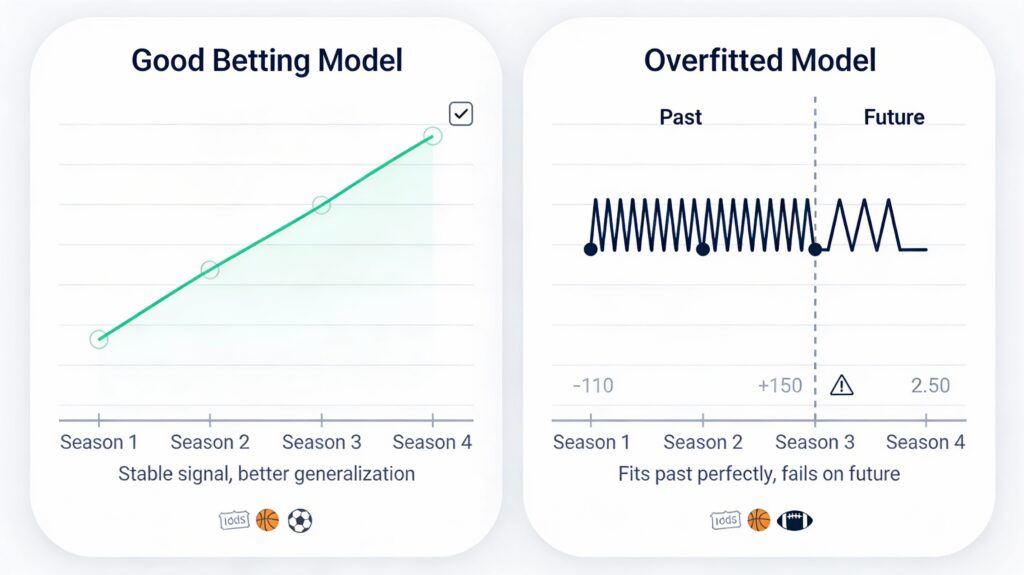
Overfitting is closely related to sample size. When datasets are too small, randomness looks meaningful.
Small samples make it easy for models to latch onto false patterns, which disappear when more data is introduced.
Overfitting vs Variance
Many bettors confuse overfitting with variance, but they are not the same.
- Variance explains short-term randomness
- Overfitting explains long-term model failure
A good model can lose due to variance.
An overfitted model will lose because it was flawed from the start.
Why Overfitting Happens in Betting Models
Too Many Variables
Adding unnecessary inputs increases noise.
Excessive Optimization
Constantly tweaking a model to improve past results weakens future performance.
Small or Biased Data
Limited datasets exaggerate coincidences.
Ignoring Market Efficiency
Highly efficient betting markets leave little room for overly complex models.
Warning Signs of an Overfitted Betting Model
- Extremely high backtest win rates
- Sharp performance drop in live betting
- Model fails when applied to a new season
- Predictions change drastically with small data updates
If a model looks perfect in hindsight but fails forward, it’s likely overfitted.
How Professionals Reduce Overfitting
Professional bettors and analytical platforms like The Over.ai design models to prioritize robustness over perfection.
Key Techniques:
- Out-of-sample testing
- Cross-validation
- Feature reduction
- Emphasis on probability and price rather than outcomes
These methods ensure models perform across different seasons and market conditions.
Expected Value Still Matters More Than Accuracy
A common mistake is focusing on win rate instead of value.
A well-designed, non-overfitted model:
- Produces positive EV
- Survives losing streaks
- Performs over large sample sizes
An overfitted model:
- Looks impressive briefly
- Fails over time
- Encourages poor bankroll decisions
For a broader statistical explanation of overfitting and why it occurs across data science and finance, this resource explains it clearly:
Overfitting Explained – Investopedia
Practical Takeaways for Bettors
- Don’t trust perfect backtests
- Demand logical explanations for every variable
- Evaluate performance over large samples
- Avoid constant strategy tweaking
- Use data-driven platforms that focus on probability and market context
Tools like TheOver.ai help bettors focus on value, pricing inefficiencies, and long-term edges, not fragile historical patterns.