
In this article
- What Is a Sports Betting System?
- Step 1: Understand the Logic Behind the System
- Step 2: Check Sample Size (Not Just Win Rate)
- Step 3: Evaluate Expected Value (EV)
- Step 4: Watch for Overfitting
- Step 5: Measure Variance and Drawdowns
- Step 6: Compare Results to Market Efficiency
- Step 7: Track Closing Line Value (CLV)
- Step 8: Evaluate Bankroll Management Rules
- Step 9: Test the System Live (Small Stakes)
- Conclusion
Sports betting systems are everywhere some promise consistent profits, others rely on complex models or “secret formulas.” But most bettors make a critical mistake: they judge systems based on short-term results, not on whether the system is fundamentally sound.
Knowing how to properly evaluate a sports betting system is essential. A good system can look bad in the short run, while a bad system can look great temporarily due to luck. This article breaks down how to assess betting systems correctly, using data, logic, and long-term performance just like professional bettors do.
What Is a Sports Betting System?
A sports betting system is a structured approach to selecting bets. It may be based on:
- Statistical models
- Market signals (line movement, sharp money)
- Situational angles
- Player or team performance data
- Automated or AI-driven predictions
The key point:
A system is not defined by wins and losses, but by decision quality and repeatability.
Step 1: Understand the Logic Behind the System
Before looking at results, ask one simple question:
Why should this system work?
A credible betting system must have:
- Clear assumptions
- Logical reasoning
- A connection to real-world factors
For example:
- A system based on closing line value (CLV) has sound logic because beating the closing line indicates pricing edge
- A system based on “teams wearing certain colors” has no logical foundation
If the logic doesn’t make sense, results won’t last no matter how good they look initially.
Step 2: Check Sample Size (Not Just Win Rate)
One of the most common evaluation mistakes is trusting small samples.
What Is Sample Size and Why It Matters in Betting
A system going 18–12 means very little.
A system going 5,500–5,200 can be far more meaningful.
General guidelines:
- < 100 bets → noise
- 300–500 bets → starting to stabilize
- 1,000+ bets → meaningful evaluation
Never judge a system on a short streak.
Step 3: Evaluate Expected Value (EV)
A winning betting system doesn’t need a high win rate it needs positive expected value.
Key questions:
- Does the system consistently beat implied probability?
- Are bets placed at good prices?
- Would the system still be profitable if variance disappeared?
A system can lose money short term and still be excellent if it produces +EV decisions.
Step 4: Watch for Overfitting
Many betting systems look amazing in backtests and fail in live betting because they are overfitted.
Warning signs:
- Extremely high historical win rates
- Too many filters or conditions
- Performance collapses in new seasons
- Constant rule changes to “fix” losses
Robust systems are simple, explainable, and adaptable.
Step 5: Measure Variance and Drawdowns
Every betting system experiences variance even profitable ones.
When evaluating a system, look at:
- Maximum drawdown
- Length of losing streaks
- Volatility of returns
If a system’s drawdowns exceed your bankroll tolerance, it may be mathematically sound—but practically unusable for you.
Step 6: Compare Results to Market Efficiency
In highly efficient markets, edges are small and hard to sustain.
Ask:
- What markets does the system target?
- Major leagues or niche markets?
- Pre-game or live betting?
Systems claiming massive edges in ultra-efficient markets should be treated with skepticism.
Step 7: Track Closing Line Value (CLV)
Professional bettors judge systems by CLV, not by wins.
If a system consistently beats the closing line:
- It’s making correct decisions
- Long-term profitability is likely
- Short-term losses are less concerning
Systems that lose CLV but win temporarily are usually driven by luck.
Step 8: Evaluate Bankroll Management Rules
A good system must include clear bankroll management.
Look for:
- Unit sizing rules
- Risk control
- No aggressive martingale strategies
Even the best system fails without proper bankroll discipline.
Step 9: Test the System Live (Small Stakes)
Before committing real money:
- Paper trade the system
- Bet minimum stakes
- Track results honestly
This helps identify:
- Execution issues
- Timing problems
- Emotional strain
Tools like TheOver.ai help bettors monitor performance, odds movement, and long-term trends objectively instead of emotionally.
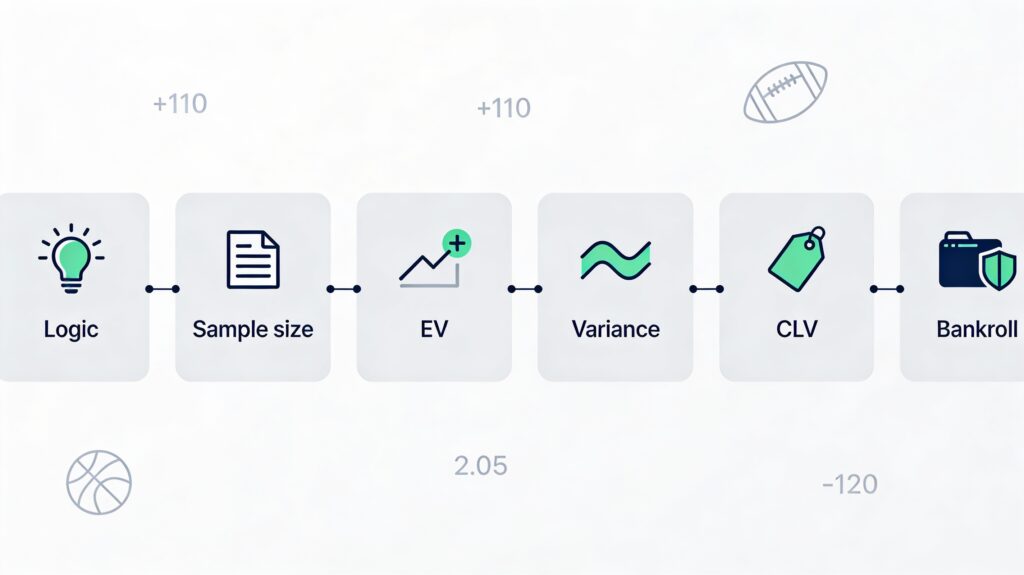
Statistical theory supports evaluating strategies over large samples, explained by the Law of Large Numbers.
Law of Large Numbers – Khan Academy
This principle explains why short-term results are unreliable and why long-term evaluation is essential.
Conclusion
Evaluating a sports betting system isn’t about finding something that wins today it’s about identifying strategies that hold up over time.
The best systems:
- Focus on value, not outcomes
- Respect variance and sample size
- Avoid overfitting
- Are supported by data and logic
By applying disciplined evaluation methods and using analytics platforms like TheOver.ai, bettors can avoid hype-driven systems and focus on approaches with real, sustainable edges.