Sports betting feels simple on the surface. You study teams, follow injuries, watch games, and back the side you believe will win. When you cash a few tickets in a row, it reinforces the idea that you’ve figured something out. But over time, most bettors see the same pattern: brief upswings followed by steady losses.
The uncomfortable truth is that most bettors don’t lose because they lack sports knowledge. They lose because they misunderstand how betting markets work. Long-term success isn’t about picking winners more often than not it’s about overcoming built-in mathematical disadvantages and making consistently positive expected value decisions.
Here’s why the majority fail to do that.
The Built-In House Edge (Vig)
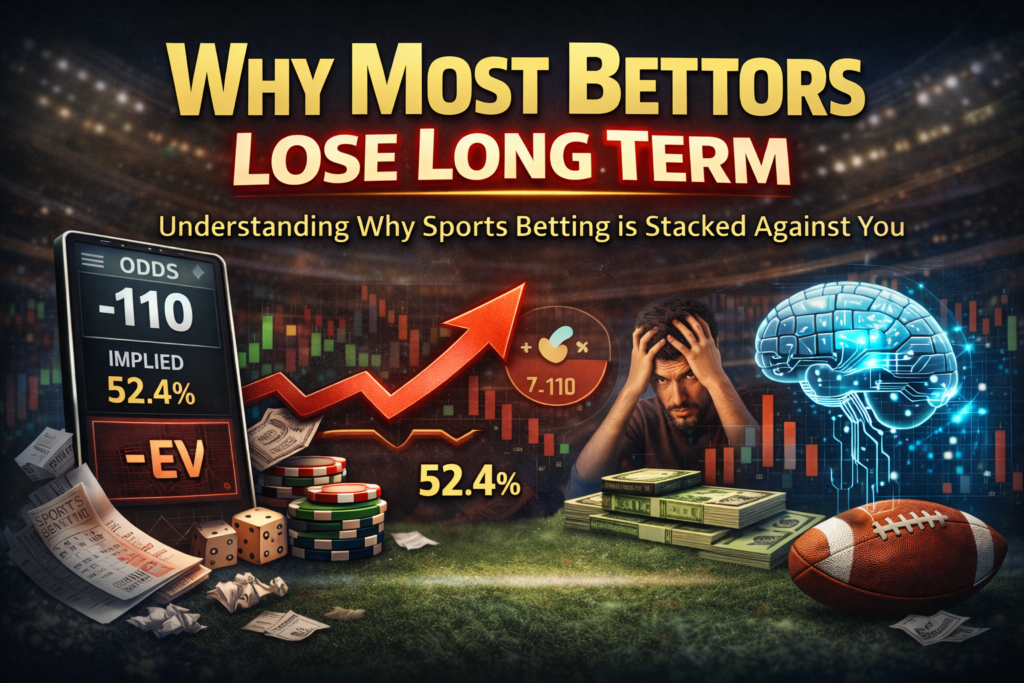
Every standard -110 bet requires you to win 52.38% of the time just to break even. That means if you win exactly half your bets which sounds respectable you are actually losing money over time.
This is the vig, the sportsbook’s built-in margin. It’s not obvious because it’s subtle. You don’t see a 5% fee deducted from your balance. Instead, the pricing quietly demands that you outperform randomness just to stay level.
Many bettors hover around 48–51% win rates. That small gap below the break-even threshold compounds into steady losses across hundreds of wagers. Without a measurable edge something we explain in detail in What Is an Edge in Sports Betting? the math is working against you from the start.
Confusing Sports Knowledge With Betting Skill
Being knowledgeable about sports does not automatically translate into betting profitability.
A bettor might understand matchups, coaching tendencies, and player rotations in depth. But sportsbooks and sharp market participants also understand those same variables. By the time a line is widely available, much of that information is already baked into the price.
Betting is not about predicting outcomes in isolation. It is about determining whether the price offered misrepresents the true probability. Most bettors focus on who they think will win. Professionals focus on whether the odds properly reflect the likelihood of that outcome.
That distinction is subtle but critical.
Ignoring Expected Value
A common mistake is evaluating bets based on whether they win or lose rather than whether they were mathematically sound.
A bettor might take a team at -150 when the true probability is only 55%. If the team wins, the bettor feels validated. But over time, repeatedly laying a price that exceeds true probability guarantees negative expected value.
Understanding expected value (EV) is foundational. A bet with positive EV will generate profit in the long run, even if it loses in the short term. Conversely, a bet with negative EV will erode a bankroll over time, even if it occasionally hits. If you’re not calculating or at least approximating EV as discussed in What Is Expected Value (EV) and Why It Matters in Betting you’re relying on short-term outcomes rather than long-term mathematics.
Emotional Decision-Making
Sports evoke emotion, and betting amplifies it.
After a loss, many bettors increase stake size in an attempt to “get it back.” After a win streak, they raise exposure because they feel confident. These adjustments are rarely based on edge magnitude. They’re reactions to recent results.
Markets punish this behavior. Variance is inevitable, even for profitable bettors. A bettor with a legitimate 55% win rate will still endure losing streaks. Without disciplined bankroll management, emotional swings lead to overexposure during downturns and unnecessary risk during upswings.
Successful bettors treat bankroll as capital, not entertainment money. Bet sizing is deliberate and proportional not reactive.
Overestimating Short-Term Performance
Humans are wired to find patterns, even when none exist. A stretch of 7 wins in 10 bets can feel like confirmation of skill. But statistically, that type of run can happen purely by chance.
Most bettors evaluate themselves on small samples weeks or even days. In reality, edge reveals itself over hundreds or thousands of wagers. The inability to zoom out leads many bettors to misjudge their actual performance.
They either become overconfident during hot streaks or abandon sound processes during cold ones. In both cases, decision-making deteriorates.
Underestimating Market Efficiency
Major sports markets especially leagues like the NFL and NBA are highly efficient. Odds reflect massive amounts of information, including injury reports, public sentiment, sharp action, and advanced modeling.
This does not mean markets are unbeatable. It does mean edges are small. A 2–3% advantage is meaningful. A consistent 10%+ edge in highly liquid markets is rare.
Many bettors assume they’ve discovered something the market has overlooked. In reality, if a betting angle is obvious, it is usually already priced in.
Poor Price Sensitivity
Small differences in price matter more than most bettors realize.
Taking -110 instead of -105 might not feel significant on a single wager. But over hundreds of bets, consistently securing better pricing improves break-even thresholds and enhances long-term ROI.
Professional bettors treat price as critical. Casual bettors often accept whatever line is available. Over time, that complacency costs money.
High-Variance Betting Habits
Parlays, longshots, and same-game combinations are attractive because they promise large payouts. However, they often carry higher effective margins for sportsbooks.
While these bets can occasionally produce big wins, they introduce substantial variance and typically reduce long-term expectation. Many bettors gravitate toward excitement rather than efficiency, prioritizing large potential payouts over sustainable advantage.
Entertainment-driven strategies are rarely aligned with long-term profitability.
Lack of Structured Tracking
Another overlooked factor is poor performance tracking.
Without recording wager size, odds taken, closing line value, and return on investment, it is impossible to evaluate whether a bettor truly has an edge. Memory is unreliable. Wins are remembered more vividly than losses.
Professionals rely on data. They track everything. They analyze patterns objectively rather than emotionally. Without structured tracking, improvement is largely guesswork.
The Structural Reality
Most bettors lose long term because they approach sports betting as fans rather than as participants in a probability market.
-They focus on outcomes rather than prices.
-They react emotionally rather than mathematically.
-They measure success in weeks rather than years.
-They underestimate the vig and overestimate their informational advantage.
Sportsbooks do not rely on predicting games perfectly. They rely on margin, volume, and human behavior. The system is designed so that undisciplined participants gradually transfer money to disciplined operators.
Final Thoughts
Losing in sports betting is not inevitable but it is the default outcome for undisciplined strategy.
To avoid becoming part of that majority, a bettor must:
- Understand break-even probabilities.
- Prioritize expected value over short-term results.
- Treat bankroll management as non-negotiable.
- Respect market efficiency.
- Make decisions based on numbers, not narratives.
Long-term success in sports betting is less about finding brilliant picks and more about eliminating structural mistakes.
Most bettors lose because they underestimate the math.
The few who win learn to respect it.