The difference between winning bettors and losing bettors is rarely intelligence. It is usually process.
Most losing bettors know sports. Many of them watch games constantly, follow injuries, and have strong opinions. However, strong opinions do not create profit. Winning bettors separate themselves by how they think about probability, pricing, and discipline over long samples.
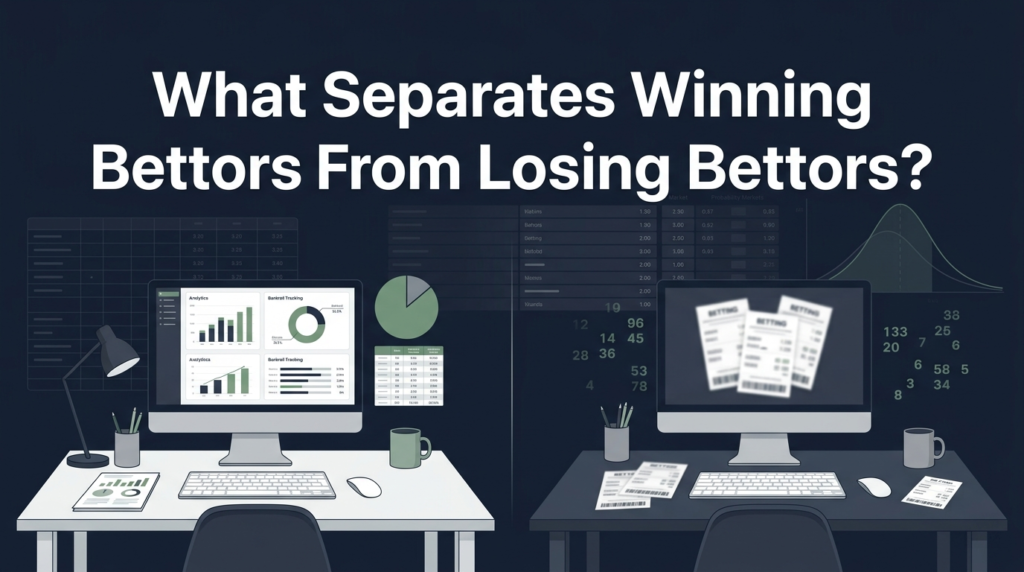
That is the real divide. Losing bettors chase outcomes. Winning bettors chase value.
Over time, that difference compounds.
Winning Bettors Think in Terms of Price, Not Just Picks
Losing bettors often ask one question first: who is going to win?
Winning bettors ask a different question: is this number worth betting?
That shift matters because betting is not a prediction contest. It is a pricing market. A favorite can win comfortably and still be a bad bet if the line was too expensive. An underdog can lose and still have been the right side if the price offered value.
This is why long term bettors focus so heavily on expected value. They understand that good betting is not about being right on every game. It is about consistently taking prices that are better than the true probability of the outcome. For a deeper foundation: What Is Expected Value and Why It Matters in Betting.
Winning Bettors Respect Probability
Winning bettors do not treat sports like certainty. They treat them like distributions.
That means they understand that a 55 percent edge still loses often. They know a good bet can lose tonight and still be profitable over 500 wagers. Losing bettors struggle with this. They often judge the quality of a bet by the result, which leads to emotional swings, bad conclusions, and unstable decision making.
This is one of the clearest separators in the betting world. Winning bettors accept uncertainty. Losing bettors fight it.
That acceptance is powerful because it keeps the process grounded. Instead of chasing certainty, sharp bettors work to improve probability estimation.
Winning Bettors Manage Their Bankroll Like Capital
A bettor can have decent reads and still lose long term because of poor bankroll management.
Losing bettors often bet too much on one game, increase stake size after losses, or treat confidence as a reason to overexpose themselves. Winning bettors do the opposite. They understand that bankroll is working capital, not entertainment money to be thrown around emotionally.
That does not mean they never bet aggressively. It means they size bets according to edge, risk, and variance rather than frustration or excitement. This is one reason disciplined bettors survive cold stretches while undisciplined bettors burn out quickly.
–What Is Bankroll Management for Sports Betting.
Winning Bettors Track Everything
Most losing bettors remember their good wins better than their bad losses. That creates a false picture of performance.
Winning bettors track results with more honesty. They record the line they got, the closing line, the outcome, the odds, the market, and the stake size. Over time, this gives them a real dataset instead of a memory based story.
Tracking matters because it answers hard questions:
- Are you actually profitable?
- Which markets are strongest for you?
- Are you beating the closing line?
- Is your edge real or imagined?
Without tracking, it is easy to believe you are close to profitability when the numbers say otherwise.
–How to Track Betting Performance Correctly.
Winning Bettors Beat the Market More Than They Beat the Game
One of the clearest signals of a sharp bettor is not just win rate. It is whether they consistently get better numbers than the market closes with.
If a bettor regularly grabs +4 and the line closes +2.5, that suggests their process is identifying value before the market fully corrects. Losing bettors usually ignore this. They focus only on who won. Winning bettors understand that beating the market is often more predictive than short term results.
This matters because the closing line is usually one of the most efficient prices available. Consistently beating it is a strong sign that a bettor is reading the market well.
–What Is Closing Line Value (CLV)?
Winning Bettors Use Data Better, Not Just More Data
Access to stats is not what separates bettors anymore. Almost everyone has data now.
What matters is interpretation.
Losing bettors often drown in information. They collect trends, recent scores, public percentages, and random angles without knowing which variables are actually predictive. Winning bettors are more selective. They focus on information that changes probability in a meaningful way, such as pace, efficiency, injury impact, matchup structure, and pricing errors.
That is why modern structured tools matter. At TheOver.ai, the logic behind smarter totals analysis is not about collecting more opinions. It is about using pace and efficiency driven projections to evaluate whether the market total is fair. Winning bettors think this way across every market. They want inputs that sharpen forecasts, not just headlines that sound convincing.
For broader context on evidence based reasoning, Khan Academy Probability and Statistics offers a solid primer on how probability and uncertainty work. For historical sports data baselines, Pro Football Reference and Basketball Reference remain useful benchmarks.
Winning Bettors Avoid Emotional Betting
This may be the biggest separator of all.
Losing bettors bet when they are bored, angry, overconfident, or desperate to recover. They chase losses, force action on national TV games, and bet favorite teams because loyalty clouds judgment.
Winning bettors try to remove emotion from the decision. They still feel disappointment and excitement, but they do not let those feelings dictate process. They pass when there is no edge. They wait for the right number. They understand that no bet is often the smartest bet.
This emotional discipline is not glamorous, but it is one of the strongest competitive advantages in betting.
Winning Bettors Understand That Small Edges Matter
Losing bettors often want huge certainty. They look for locks, guaranteed spots, and obvious mismatches.
Winning bettors are more comfortable with smaller edges. They know that long term profit often comes from small but repeatable advantages. A half point. A five cent price difference. A total that is off by one possession. These things may seem minor in isolation, but over hundreds of bets they become meaningful.
That mindset is important because it keeps bettors realistic. Sportsbooks are sharp. Markets are efficient. Huge mistakes are rare. Winners learn to live in the margins.
Common Habits of Losing Bettors
The patterns are usually familiar:
- They bet based on confidence instead of price
- They chase losses
- They overreact to recent games
- They do not shop for the best line
- They fail to track results honestly
- They confuse a winning bet with a good bet
- They rely on narratives more than probability
None of these habits guarantee immediate failure. The problem is that they quietly destroy long term performance.
Final Thoughts
What separates winning bettors from losing bettors is not secret information or magical intuition. It is structure.
Winning bettors think in terms of value. They respect probability. They manage bankroll carefully. They track performance honestly. They use data with discipline. Most importantly, they do not let short term emotion override long term process.
That is the real divide.
Losing bettors want to be right. Winning bettors want to be profitable.