If you’ve ever placed a standard sports bet, you’ve already paid the vig—whether you realized it or not. The vig, also called juice, is the built-in fee sportsbooks charge for taking your wager. It is the primary way sportsbooks generate consistent profit.
Understanding how vig works is essential because it directly affects:
- Your potential payout
- The true probability behind odds
- Your long-term ROI
- Whether a bet is actually profitable
Without accounting for vig, it is impossible to accurately evaluate betting value.
What Is Vig (Juice)?
The vig is the margin sportsbooks embed into betting odds to ensure they earn money over time.
In simple terms, it is the commission sportsbooks charge for facilitating the bet.
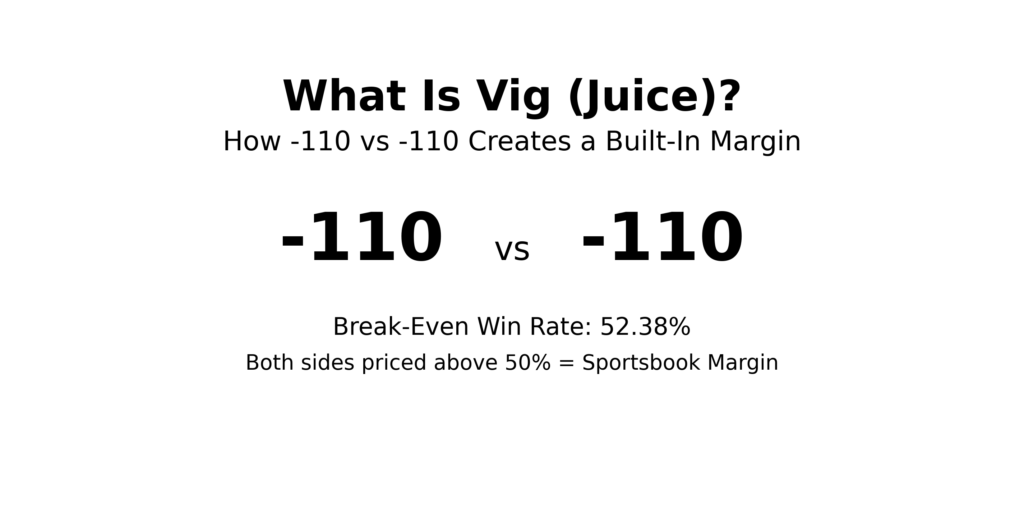
Most standard point spread and total bets are priced at:
- −110
- −110
At first glance, this looks like a 50/50 wager. But mathematically, it is not.
If a bet were truly fair with no margin, both sides would be priced closer to:
- −100
- −100
The extra −10 is the sportsbook’s edge.
How Vig Works in Practice
Let’s break it down.
If you bet $110 at −110 odds:
- You win $100 in profit
- Or lose the full $110
To break even long term at −110, you must win:
52.38% of your bets
Anything below that, and the vig slowly erodes your bankroll.
This is why even skilled bettors struggle without a true edge.
Converting Vig Into Implied Probability
Odds represent probability but vig inflates those probabilities beyond 100%.
Example:
- Team A −110 → 52.38% implied probability
- Team B −110 → 52.38% implied probability
Add them together:
52.38% + 52.38% = 104.76%
That extra 4.76% is the sportsbook’s margin.
How to Convert American Odds to Implied Probability
Understanding this concept is critical when evaluating whether a bet offers value.
Why Sportsbooks Use Vig
Sportsbooks are not trying to predict winners they are trying to manage risk.
If they take equal action on both sides:
- They collect vig from losing bets
- They pay out winners
- They profit from the margin
This business model ensures consistent revenue regardless of game outcomes.
Vig in Different Bet Types
Not all bets carry the same margin.
Standard Spread / Totals
Usually −110 / −110 (moderate vig)
Moneylines
Margins vary depending on pricing and market efficiency.
Parlays and Same-Game Parlays
Often contain higher effective vig, even if not obvious.
What Are Parlays and Why Are They Risky?
Live Betting
In-play markets often have slightly wider spreads and faster pricing adjustments, increasing effective margin.
How Do Live (In-Play) Bets Work?
The more complex the bet, the harder it is to spot the built-in edge.
Reduced Juice and Why It Matters
Some sportsbooks offer reduced juice lines, such as:
- −105 / −105
- −108 / −108
This small difference significantly lowers the break-even rate.
Example:
- At −110 → 52.38% needed to break even
- At −105 → 51.22% needed
That 1% difference can dramatically impact long-term ROI.
What Is ROI in Sports Betting?
This is why line shopping matters.
What Is Line Shopping and Why It’s Important
Vig vs True Probability
Vig distorts the “true” probability of an event.
If two evenly matched teams are priced at −110 on both sides, neither actually has a 52.38% chance of winning. The sportsbook has simply added margin.
To evaluate true probability, bettors must:
- Remove the vig from the odds
- Compare fair odds to offered odds
- Calculate expected value
What Is Expected Value (EV) and Why It Matters in Betting
How Vig Affects Long-Term Results
Because of vig:
- A 50% win rate loses money
- Small edges matter
- Consistency matters more than streaks
Even strong bettors must overcome vig before turning profit.
This is why professionals focus on:
- Beating the closing line
- Securing better prices
- Reducing juice whenever possible
Why Beating the Closing Line Matters
Key Takeaways
- Vig (juice) is the sportsbook’s built-in commission.
- It inflates implied probabilities above 100%.
- Standard −110 odds require a 52.38% win rate to break even.
- Reduced juice significantly improves long-term profitability.
- Understanding vig is essential for calculating real value.
Conclusion
Vig is the silent force behind every sports bet. It doesn’t determine who wins a game—but it determines who wins long term.
If you ignore vig, you ignore the most important mathematical component of sports betting. If you understand it, remove it from probability calculations, and minimize it through line shopping, you dramatically improve your chances of sustained success.
In sports betting, margins are small and vig is the margin that matters most.