True Shooting Percentage, often abbreviated as TS percent, is one of the most important efficiency metrics in modern basketball analytics. While traditional field goal percentage only measures shots made from the field, true shooting percentage accounts for three point shots and free throws.
In other words, it measures overall scoring efficiency.
For NBA bettors, that distinction matters. Teams and players who appear productive based on raw points per game may actually be inefficient when adjusted for shot value. Therefore, understanding TS percent improves projection accuracy in spreads, totals, and player props.
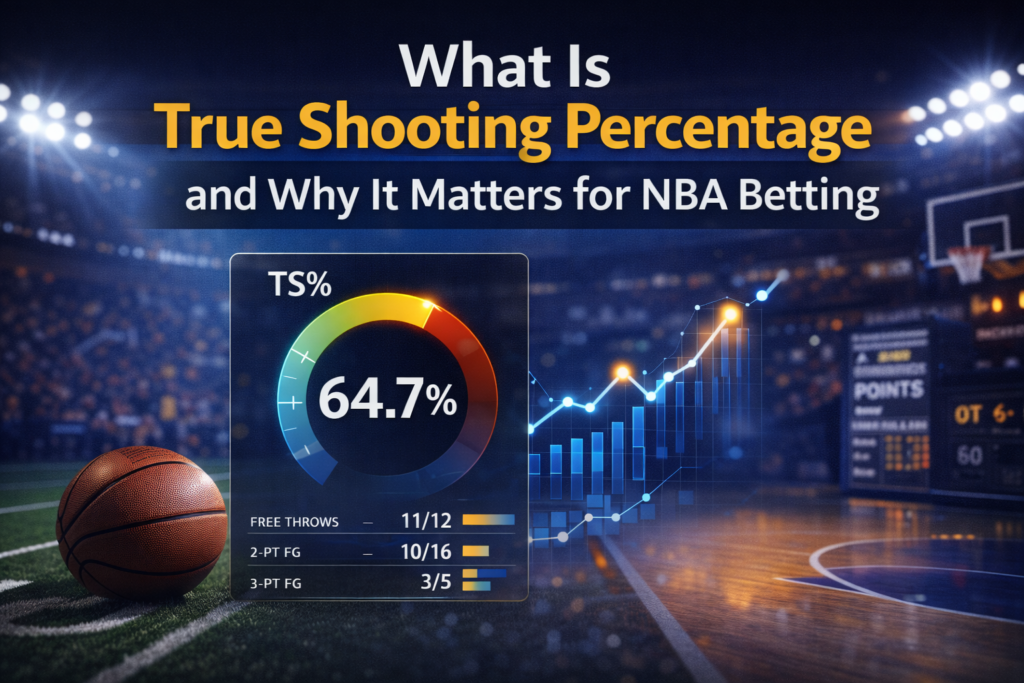
What Is True Shooting Percentage?
True Shooting Percentage measures how efficiently a player scores by accounting for:
• Two point field goals
• Three point field goals
• Free throws
The formula adjusts scoring output relative to total shooting attempts, including trips to the free throw line.
The simplified formula is:
TS percent equals Points divided by 2 multiplied by Field Goal Attempts plus 0.44 multiplied by Free Throw Attempts.
The 0.44 factor estimates how many free throws represent full shooting possessions.
According to Basketball Reference, league average true shooting percentage typically falls between 57 percent and 59 percent in recent seasons. Anything significantly above that indicates strong scoring efficiency.
Why True Shooting Percentage Is Better Than Field Goal Percentage
Traditional field goal percentage treats all made shots equally. However, a three point shot produces 50 percent more points than a two point shot. Therefore, treating them equally misrepresents efficiency.
For example:
• Player A shoots 50 percent on two point attempts
• Player B shoots 40 percent from three
Player B actually produces more points per shot attempt, even though his field goal percentage is lower.
True shooting percentage captures that difference.
It also accounts for free throws, which are among the most efficient scoring opportunities in basketball.
As a result, TS percent provides a clearer picture of real scoring value.
Why True Shooting Percentage Matters for NBA Betting
NBA betting markets price games based on projected scoring efficiency and pace. Therefore, TS percent becomes highly relevant.
If a team ranks high in points per game but below average in true shooting, that production may be inflated by pace rather than efficiency. Conversely, a team with average scoring but elite TS percent may be more dangerous in slower games.
Understanding this distinction improves totals analysis.
If you have not explored pace influence yet, see How Pace of Play Affects Totals Betting.
True Shooting Percentage and Totals Betting
Totals markets rely on possession efficiency. Because TS percent measures scoring efficiency per shooting opportunity, it directly affects projected points per possession.
When two high TS teams face each other, scoring efficiency rises. Even at moderate pace, efficient shot conversion increases over probability.
Conversely, if both teams rank below league average in TS percent, unders become more viable, especially in slower paced matchups.
Platforms such as https://www.theover.ai/ model totals through possession volume and efficiency metrics. True shooting percentage plays an indirect role in those projections because it reflects offensive conversion quality.
However, TS percent must be evaluated alongside defensive efficiency and pace.
True Shooting Percentage and Player Props
TS percent also impacts player props.
For example:
• High TS players convert shots efficiently
• Players drawing frequent free throws boost TS
• Usage heavy but inefficient players may underperform scoring props
If a player averages 25 points per game but has declining TS percent over recent weeks, regression may follow. Efficiency drops often precede scoring declines.
Understanding regression is critical. If you need background, see What Is Regression to the Mean in Betting?
Efficiency stabilizes over larger samples. Short term spikes may correct quickly.
League Context and Efficiency Trends
League wide TS percent changes over time.
Rule changes, spacing evolution, and three point volume influence efficiency levels. For example, as three point attempts increased league wide, overall TS percent improved.
Therefore, comparing players to league average matters more than raw percentage.
According to historical data compiled by Basketball Reference, league average TS percent in the early 2000s was significantly lower than current averages.
Context always matters.
How Sportsbooks Use Efficiency Metrics
Modern sportsbooks incorporate efficiency metrics into power ratings. Offensive rating, defensive rating, and true shooting percentage indirectly influence opening lines.
Therefore, TS percent is not hidden information. It is widely known.
However, markets can misprice recent form. Public bettors often overreact to scoring totals without evaluating efficiency quality.
When TS percent suggests sustainable efficiency but market perception lags, small edges may appear.
Still, edge exists only when projected probability differs meaningfully from implied probability.
For foundational understanding, see What Is Expected Value and Why It Matters in Betting?
Final Thoughts
True Shooting Percentage measures scoring efficiency by accounting for two point shots, three point shots, and free throws. It provides a more accurate view of offensive performance than traditional field goal percentage.
For NBA bettors, TS percent improves projections in spreads, totals, and player props. However, it must be analyzed alongside pace, defensive metrics, and sample size.
Efficiency drives scoring probability. Probability determines value. Value determines long term profitability.
True shooting percentage is not a shortcut. It is a refinement tool within a larger probability framework.