Reverse line movement is one of the most talked-about and misunderstood signals in sports betting.
At first glance, it seems simple: when most bettors are on one side of a game, but the betting line moves in the opposite direction, something unusual is happening.
That “something” is typically sharp money.
Reverse line movement (RLM) is not a betting strategy by itself. It is a market signal a clue about where influential money is landing and how sportsbooks are reacting to it.
Understanding how and why it happens can help bettors interpret market behavior more intelligently.
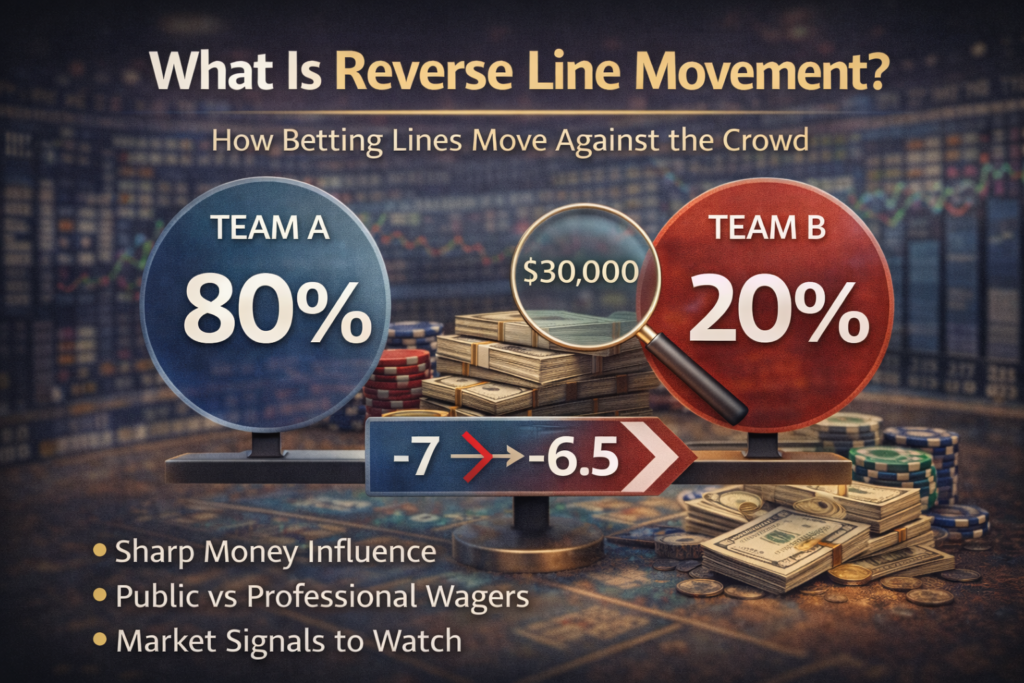
The Basic Definition
Reverse line movement occurs when:
- The majority of betting tickets are on one side
- The betting line moves toward the opposite side
For example:
| Metric | Value |
|---|---|
| 70% of tickets | On Team A -3 |
| Line moves | From -3 to -2.5 |
Even though most bets are on Team A, the line shifts in favor of Team B.
This suggests that larger or more respected wagers are influencing the market in the opposite direction.
Why Lines Move in the First Place
To understand reverse line movement, you must understand how lines normally move.
Sportsbooks adjust lines based on:
- Risk exposure
- Sharp money
- Injury updates
- Market consensus
- Liquidity
Contrary to popular belief, sportsbooks do not simply aim for 50/50 ticket splits. They aim to manage risk while pricing the market efficiently.
If 75% of small public bets are on one side, but sharp bettors place significant money on the other, sportsbooks may move the line toward the sharper action.
This creates reverse line movement.
What Is Line Movement and Why Should Bettors Care?
Public Money vs Sharp Money
Reverse line movement typically reflects the difference between public money and sharp money.
Public money:
- Smaller wagers
- Emotion-driven
- Narrative-based
- Heavily influenced by recent performance
Sharp money:
- Larger wagers
- Model-driven
- Probability-focused
- Often placed early
If sharp bettors identify value on one side, sportsbooks respect that action more than high-volume public tickets.
This dynamic drives RLM.
What Are Sharp Money Indicators?
A Real-World Example
Imagine an NFL game opens at:
Team A -4
Public betting data shows:
- 68% of tickets on Team A
- 32% of tickets on Team B
However, the line moves to:
Team A -3
Why would sportsbooks make it cheaper to bet on the side already receiving most tickets?
The most common explanation is that large, respected wagers came in on Team B +4. The sportsbook adjusted to protect against sharp exposure.
That shift is reverse line movement.
Why Reverse Line Movement Matters
Reverse line movement can indicate:
- Sharp disagreement with public perception
- Market inefficiency created by emotional betting
- Value opportunities on the less popular side
However, it is not a guarantee of profitability.
It is a signal not a shortcut.
Successful bettors use RLM as one variable within a broader analytical framework, not as a standalone strategy.
Common Misconceptions About Reverse Line Movement
Many bettors misunderstand RLM in several ways.
Misconception 1: Reverse Line Movement Always Means Bet the Opposite Side
Not necessarily.
While RLM can suggest sharp action, it does not automatically confirm positive expected value. You still must compare implied probability to your estimated probability.
Blindly following RLM without evaluating true probability is speculation.
Misconception 2: All Line Movement Is Sharp
Lines move for many reasons:
- Injury news
- Weather reports
- Market correction
- Liquidity adjustments
Reverse movement is only meaningful when ticket percentages and timing align.
Context matters.
Misconception 3: Ticket Percentage Alone Is Enough
Ticket count does not reflect wager size.
70% of tickets might represent small bets. If the other 30% represent large wagers, money distribution may tell a different story.
Professional bettors monitor both ticket percentage and money percentage before drawing conclusions.
Reverse Line Movement in Totals Markets
RLM is not limited to point spreads.
Totals markets often show reverse movement when:
- Public bettors heavily favor overs
- Sharp money identifies value on unders
- The total drops despite majority over tickets
Because public bettors naturally prefer overs, reverse movement toward the under can be particularly revealing.
Advanced probability modeling such as pace and efficiency projections used in structured systems like TheOver.ai helps determine whether such movement reflects real mispricing or simply market adjustment.
RLM highlights disagreement. Modeling determines value.
Reverse Line Movement vs Market Efficiency
Modern sports betting markets are highly efficient.
RLM does not imply sportsbooks are “wrong.” It reflects:
- Information asymmetry
- Capital weighting
- Risk management
The market is constantly adjusting.
Reverse line movement shows where influential money disagrees with majority opinion.
Understanding that distinction prevents overreaction.
How to Use Reverse Line Movement Properly
Reverse line movement should be used as:
- A confirmation tool
- A context signal
- A market behavior indicator
It should not replace:
- Probability modeling
- Expected value calculation
- Edge analysis
- Bankroll discipline
Before betting based on RLM, ask:
- Does the number now create positive expected value?
- Has implied probability shifted meaningfully?
- Does my model agree with the movement?
Without those steps, RLM becomes noise.
The Strategic Value of Reverse Line Movement
Reverse line movement reveals tension between public perception and professional opinion.
In highly public games, narratives often dominate ticket distribution. Sharp money can quietly move numbers in the opposite direction.
That divergence can create opportunity but only if supported by structured probability analysis.
The market speaks through price movement.
RLM is one way of listening.
Final Thoughts
Reverse line movement occurs when betting lines shift against the majority of tickets, often indicating sharp influence. It reflects capital weight, not ticket count. It signals disagreement, not certainty.
Used correctly, it provides insight into market behavior. Used blindly, it becomes another emotional shortcut.
In sports betting, price movement is information.
But edge still requires probability.