Forward testing is the process of evaluating a betting model on new data that was not used during model development. In simple terms, it means letting the model make predictions in real time, or on a fresh unseen sample, and then tracking how it performs going forward.
That sounds similar to backtesting, but the difference is important. Backtesting asks how a model would have performed on past data. Forward testing asks whether the model still works after the past is over.
For serious bettors, that distinction matters a lot. A model can look excellent in historical testing and still fail once real market conditions, new games, and live pricing take over. Forward testing is what helps separate a model that looked good from a model that is actually useful.
Why Forward Testing Matters
Most betting models begin with historical data. A bettor builds rules, adjusts inputs, tests ideas, and tries to find patterns that appear profitable. That process is valuable, but it has limits. The more you study the past, the easier it becomes to build something that fits yesterday better than tomorrow.
Forward testing protects against that problem. It forces the model to operate on information it has never seen before. As a result, it becomes a more honest check on whether the strategy has predictive value.
This is especially important in sports betting because markets adapt. Injury reporting changes, sportsbooks improve, public behavior shifts, and team strategies evolve. A model that performed well on old data may struggle if its logic does not hold up in a live environment.
– What Is Backtesting in Sports Betting?
Forward Testing vs Backtesting
Backtesting and forward testing belong together, but they do different jobs.
Backtesting answers this question: if I had used this model in the past, how would it have performed?
Forward testing answers this question: now that the model is built, does it still perform on new games and real prices?
That difference sounds small, but it changes everything. Backtesting is partly a research tool. Forward testing is a reality check.
A simple comparison helps:
| Method | Main Purpose | Uses Historical Data Used in Development? | Main Risk |
|---|---|---|---|
| Backtesting | Evaluate past performance | Yes | Overfitting |
| Forward Testing | Evaluate future live performance | No | Real world failure |
A model that passes both tests is much stronger than one that only looks good in the past.
What Forward Testing Actually Looks Like
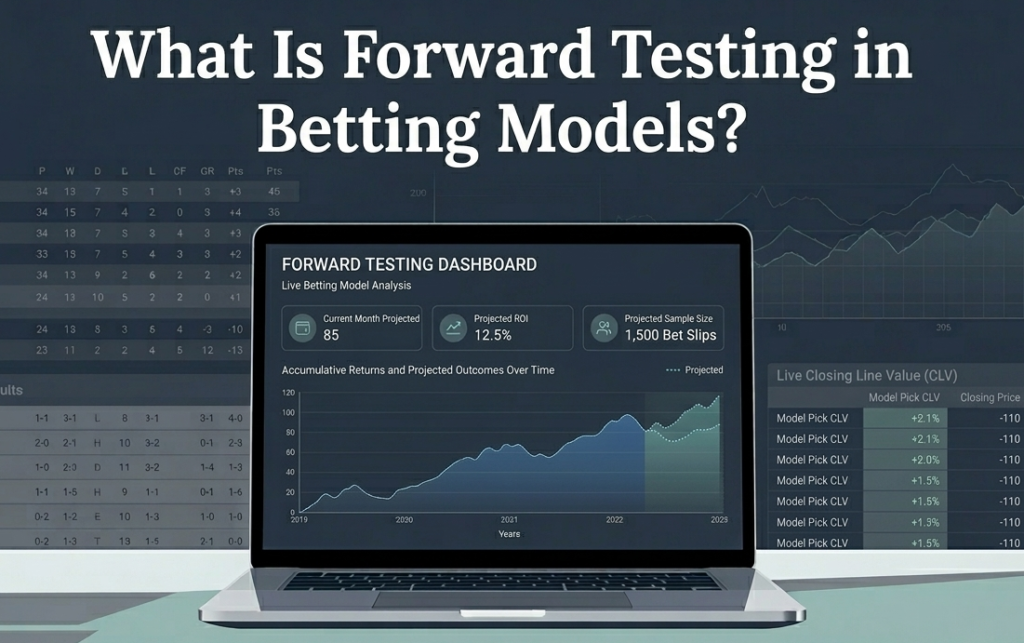
In practice, forward testing usually starts after a model is finalized. The bettor freezes the rules, stops changing variables, and begins recording every signal the model produces from that point onward.
For example, imagine a totals model that identifies overs when projected pace and offensive efficiency exceed the market number by a certain amount. Once the model is locked, the bettor tracks every future qualifying bet. Then they record:
- The line at time of signal
- The closing line
- The result
- ROI
- Hit rate
- Closing line value
That is forward testing. The model is no longer being tuned on the same sample. It is being judged on fresh evidence.
– What Is Closing Line Value (CLV)?.
Why Forward Testing Is More Honest
Backtests can be impressive for the wrong reasons. A bettor can tweak filters, remove weak ranges, or fine tune thresholds until a model looks excellent. Even when that is done with good intentions, the result can still be overly tailored to the past.
Forward testing removes much of that comfort. The rules are already set. The games have not happened yet. The bettor cannot quietly rewrite the model after seeing results without invalidating the process.
That is what makes forward testing more honest. It shows whether the logic is durable when uncertainty is real.
In betting, honesty matters because variance can hide the truth in either direction. A weak model can run hot for a while, and a strong model can suffer a rough stretch. Forward testing does not eliminate variance, but it gives you a cleaner environment to evaluate whether the model has real edge over time.
Key Metrics to Track During Forward Testing
A proper forward test should track more than wins and losses. Short term records can be misleading, especially in volatile markets.
The most useful metrics include:
ROI
Return on investment shows how much profit the model generates relative to the amount wagered. This is usually the clearest performance measure.
Closing Line Value
If the model consistently gets better numbers than the market closes with, that suggests it is identifying value before the market fully corrects.
Sample Size
A twenty bet sample is not enough to judge most models. The larger the sample, the more confidence you can place in the results.
Average Edge by Bet Type
It helps to know whether the model performs better in sides, totals, or props. Forward testing can reveal where the model is strongest and where it may need to be limited.
Stability Over Time
A model that performs similarly across months or different parts of the season is usually more trustworthy than one that depends on a narrow window.
– What Makes a Betting Model Profitable?
Forward Testing in Live Betting vs Paper Testing
There are two common ways to forward test a model.
The first is paper testing. That means recording the bets without actually placing them. This is useful early on because it lets the bettor evaluate the model without risking money. It also helps expose operational issues such as timing, market availability, and line movement.
The second is live testing. That means placing real bets and tracking real bankroll impact.
Paper testing is safer, but it has one weakness: it can be cleaner than reality. In real betting, odds move, some prices disappear, and execution matters. Live testing captures that friction.
Many serious bettors use both. They may begin with paper testing to confirm the model’s stability, then move to small real stakes once the process looks credible.
Forward Testing Is Essential for Totals Models
Forward testing is especially important in totals betting because totals are sensitive to pace, efficiency, lineup changes, and market speed. A projection model may look excellent on historical scoring data, but it still needs to prove that it can beat current market numbers.
That is where structured scoring models become interesting. At TheOver.ai, the core logic of totals analysis centers on pace and efficiency driven scoring projections. Forward testing is what shows whether those projections continue to outperform the market once games move from historical research to live decision making.
In other words, the model’s real test begins after the build is done.
Common Mistakes in Forward Testing
Many bettors say they are forward testing when they are really still adjusting the model every week. That is one of the biggest mistakes.
A proper forward test requires discipline. Common errors include:
- Changing the model after a losing stretch
- Quietly excluding bad signals
- Using unrealistic prices instead of available market prices
- Judging the model too early on a tiny sample
- Focusing only on win rate instead of CLV and ROI
These mistakes weaken the process because they blur the line between testing and constant re-optimization.
Another mistake is expecting instant proof. Forward testing often takes time. A model may need dozens or hundreds of bets before its true profile becomes clear.
How Long Should Forward Testing Last?
There is no perfect rule, but the answer depends on the market and the frequency of signals.
A model that triggers multiple bets per day can build evidence faster than one that only creates a few bets per week. Still, the general principle is simple: the sample must be large enough to reduce noise and reveal whether the edge is stable.
That means forward testing should usually continue until you have enough volume to judge:
- Whether ROI remains positive
- Whether CLV is consistent
- Whether the edge survives different market conditions
- Whether performance changes by sport, market, or timing
The goal is not just to see profit. The goal is to see whether the model behaves like a real repeatable process.
Forward Testing and Model Confidence
Forward testing does not guarantee a model is good. It improves confidence when the results remain strong after development is complete.
That confidence should still be measured. Even good forward tested models can break down if:
- The market catches up
- The sport environment changes
- The model relied on outdated assumptions
- Execution quality declines
This is why model evaluation never fully ends. Forward testing is not the last step forever. It is the stage where the model proves whether it deserves trust.
Final Thoughts
Forward testing in betting models means evaluating a finished strategy on new, unseen data instead of the historical sample used to build it. It matters because it tests whether the model can survive real market conditions rather than just explain the past.
Backtesting shows what would have happened. Forward testing shows what is happening now.
That makes it one of the most important steps in serious betting analysis. It helps reveal whether a model has real predictive value, whether it beats market prices consistently, and whether its edge survives outside the lab.