Backtesting is the process of testing a betting strategy on historical data to see how it would have performed in the past. In simple terms, it means taking a model, rule set, or betting system and asking one question: if I had used this approach before, what results would it have produced?
That sounds straightforward. However, backtesting is much more than checking whether an idea “would have won.” A proper backtest helps bettors evaluate whether a strategy has logical value, whether it holds up over a meaningful sample, and whether the apparent edge survives after realistic pricing and variance are considered.
Used correctly, backtesting is one of the most important tools in sports betting analysis. Used poorly, it becomes a way to fool yourself with nice looking results.
Why Backtesting Matters
Sports betting is full of ideas that sound smart. A bettor may believe that road underdogs are undervalued, that certain pace profiles lead to inflated totals, or that a specific player prop market reacts too slowly to role changes. The problem is that intuition alone does not tell you whether those ideas actually work.
Backtesting adds discipline. It forces you to take a theory and measure it against real historical markets. Instead of saying, “this feels profitable,” you can say, “over 800 bets at market prices, this angle produced a positive return.”
That shift is important because betting is about evidence, not just opinion.
What a Backtest Actually Includes
A backtest usually starts with three things:
- A clear betting rule or model
- A historical dataset
- A way to measure results
For example, imagine you believe NFL underdogs of +3.5 or more are undervalued when facing teams on short rest. A backtest would require you to define that rule clearly, collect historical games that fit it, use the actual market prices from those games, and then calculate win rate, ROI, and closing line performance.
The key word here is clearly. A vague idea cannot be tested properly. If the rule keeps changing while you look through past results, the test loses value.
Backtesting vs Trend Hunting
A lot of bettors confuse backtesting with trend hunting. They are not the same thing.
Trend hunting usually starts with a result and works backward. A bettor notices that some angle went 14 and 4, then presents it as evidence of value. The problem is that many of those trends are random, overly specific, or not predictive.
Backtesting starts with a reasoned hypothesis. Then it tests whether that idea holds up over a meaningful sample.
For example, “teams from the West Coast playing a 1 p.m. Eastern kickoff underperform” is at least tied to travel and body clock theory. That can be tested. On the other hand, “favorites wearing blue jerseys after a bye are 9 and 2” is just noise unless there is a real mechanism behind it.
–How to Use Historical Data for Betting
–What Makes a Betting Model Profitable?
What Good Backtesting Looks Like
A good backtest has structure. It should answer a practical betting question, use consistent rules, and rely on realistic market data.
A strong backtest usually includes:
- A large enough sample size
- Historical odds, not just game results
- Clear entry rules
- Realistic bet timing
- Transparent performance metrics
That last point matters a lot. A strategy can win more than half its bets and still lose money if the prices are poor. Likewise, a strategy can hit below 50 percent and still be profitable at plus money.
That is why backtesting must be tied to price, not just outcomes. For a bettor, the question is not “did this side win?” The real question is “did this strategy beat the implied probability of the odds?”
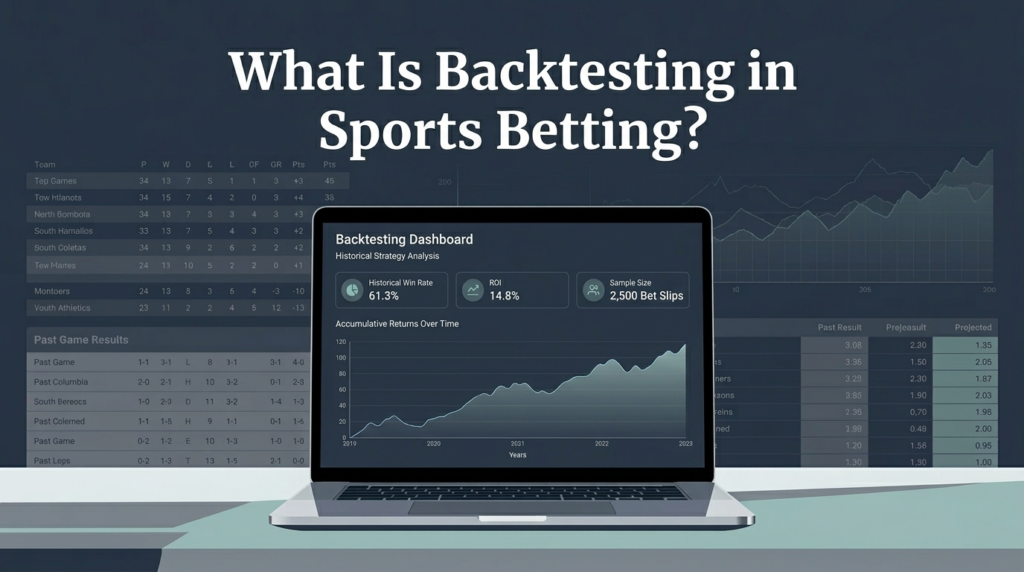
The Most Important Metrics in a Backtest
When evaluating a backtest, bettors usually focus on four core metrics.
Win Rate
Win rate tells you how often the strategy won. It is useful, but it is incomplete. A 56 percent win rate at -130 is not the same as a 56 percent win rate at -105.
ROI
Return on investment shows how much profit the strategy produced relative to amount wagered. This is often the most important bottom line measure.
Sample Size
A strategy that went 18 and 7 may look exciting, but that is still a small sample. A strategy that stayed profitable over 900 bets is much more meaningful.
Closing Line Value
If a backtested angle consistently beat the closing line, that strengthens the case that it identified market inefficiency rather than random luck.
–What Is Expected Value and Why It Matters in Betting
–What Is Closing Line Value (CLV)?
Why Backtests Often Look Better Than Reality
This is where many bettors get into trouble. Backtests often produce cleaner results than real world betting because the testing process can hide weaknesses.
One common problem is selection bias. A bettor may test ten ideas, throw away the nine that failed, and present the one survivor as if it was discovered honestly. Another problem is data snooping. The more you search through old data, the more likely you are to find something that worked by chance.
There is also survivorship bias. Sometimes only the best looking systems get discussed, while all the failed models disappear.
Then there is the most dangerous issue of all: overfitting.
Overfitting Can Ruin a Backtest
Overfitting happens when a model or strategy becomes too closely tailored to past data. It starts explaining the historical sample beautifully, but fails once new games arrive.
For example, imagine you build a betting system that only triggers when:
- The home team has lost two straight
- The total is between 44 and 47
- Wind is below 8 mph
- The away team allowed more than 6.1 yards per play last week
- The game is played in October or November
That system might test well historically, but it may only be capturing noise. The more specific and customized the rules become, the more likely the strategy is fitting the past instead of identifying a real edge.
That is why serious bettors often split their data into in sample and out of sample testing. One portion is used to develop the strategy. Another is used to see if it still works on unseen data.
For external support here, Khan Academy’s overview of overfitting and model performance is a useful general reference, and Pro Football Reference or Basketball Reference can help with historical sports datasets.
Backtesting Works Best With Market Data
One of the biggest mistakes bettors make is backtesting a strategy only on game outcomes. That is not enough.
Suppose your rule says to bet every underdog that wins at least 45 percent of the time in your model. If you test only game results, you are missing the most important part: price. Betting is not just about being right on outcomes. It is about whether the line offered you enough value.
A proper backtest should include:
- Opening price or price at time of bet
- Final market result
- Whether the number beat closing line
- Net profit after vig
Without that, the backtest may look smarter than it really is.
How Backtesting Helps Totals Bettors
Backtesting is especially useful in totals betting because totals often depend on repeatable variables such as pace, efficiency, weather, shot quality, or matchup structure.
For example, if you want to test whether fast paced teams with weak red zone defenses create inflated overs, you can build a historical dataset around those conditions and evaluate the outcomes at market prices.
At TheOver.ai, this kind of logic sits at the center of projection based totals analysis. Historical pace and efficiency data matter because they improve scoring forecasts. The goal of backtesting is not to prove that a narrative sounds good. The goal is to test whether those variables actually created value against the market over time.
A Simple Backtesting Workflow
A clean workflow usually looks like this:
- Start with a betting hypothesis.
- Define the exact rule set.
- Gather historical market and performance data.
- Test the strategy over a large enough sample.
- Measure ROI, win rate, and closing line value.
- Check whether the results survive on unseen data.
- Decide whether the idea has real predictive value.
This process sounds simple, but the discipline is what makes it hard.
Common Backtesting Mistakes
Several mistakes show up again and again.
First, bettors use too small a sample. A strategy that looked amazing over 30 bets may collapse over 300.
Second, they ignore line availability. A backtest that assumes you always got the best number may not reflect reality.
Third, they keep adjusting the rules until the results look impressive. That often creates overfitting.
Fourth, they forget that markets evolve. A system that worked five years ago may lose value once sportsbooks and bettors adapt.
Finally, they mistake a profitable backtest for a guaranteed future edge. A strong backtest is evidence, not proof.
Final Thoughts
Backtesting in sports betting means testing a model or strategy on historical data to see how it would have performed at real market prices. Done well, it helps bettors move from opinion to evidence. It forces ideas to prove themselves.
However, a backtest is only as good as the rules, data, and assumptions behind it. If the sample is weak, the prices are unrealistic, or the model is overfit, the results can be dangerously misleading.
That is why backtesting should be treated as a filter, not a guarantee. It helps you eliminate weak ideas, strengthen better ones, and understand whether your strategy has any real chance of beating the market.