Correlated bets are wagers where the outcome of one bet directly influences the probability of another. In simple terms, the two bets are connected. When one outcome becomes more likely, the other often becomes more likely as well. Because of this relationship, correlation changes how probability should be calculated.
At first glance, correlated bets may seem like a creative way to build parlays. However, sportsbooks treat them differently for a reason. When outcomes are linked, risk shifts. Therefore, understanding correlation is essential if you want to evaluate same game parlays, totals, and player props correctly.
What Does Correlation Mean in Sports Betting?
Correlation refers to a statistical relationship between two variables. In betting, this means that one event affects the likelihood of another.
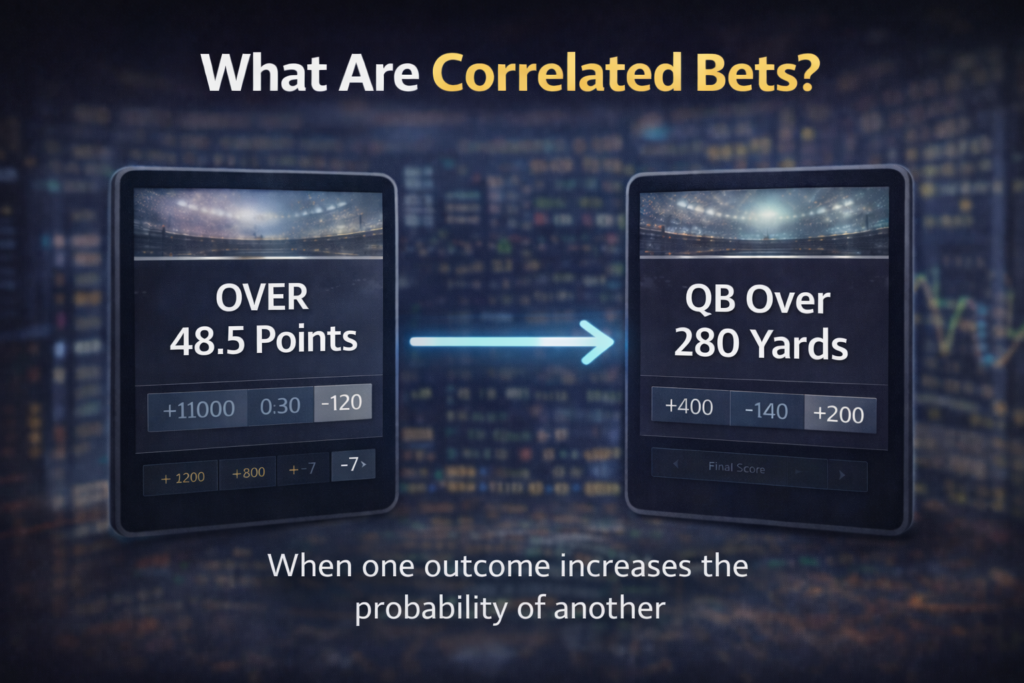
For example, consider an NFL game with a high projected total. If the game goes over 48.5 points, it becomes more likely that the quarterback throws for high yardage. More passing volume usually leads to more scoring. As a result, betting the over and betting the quarterback over his passing yards are connected outcomes.
Because these outcomes move together, they are positively correlated.
In contrast, some bets move against each other. If a team runs the ball heavily and slows the game down, total points may decrease while rushing attempts increase. That creates a different type of relationship.
Understanding these interactions improves probability estimation.
Correlated Bets vs Independent Bets
To understand correlated bets clearly, it helps to compare them with independent bets.
Independent bets have no statistical relationship. One outcome does not influence the other.
For example:
- Lakers moneyline
- Manchester United moneyline
These events occur in separate competitions. One result does not change the probability of the other.
However, consider this combination:
- Chiefs minus 3
- Over 47 total points
If the Chiefs cover, it often means their offense performed well. Consequently, scoring likely increased. Therefore, these bets are partially correlated. The success of one increases the likelihood of the other.
This distinction matters because independent bets allow simple probability multiplication. Correlated bets do not.
Why Sportsbooks Restrict Correlated Parlays
Sportsbooks limit obvious correlated bets to prevent pricing inefficiencies.
For example, you usually cannot parlay:
- Team A moneyline
- Team A minus 3
If Team A wins by more than three points, both bets win. Because these outcomes overlap directly, sportsbooks would be mispricing the combined probability if they allowed it at standard parlay odds.
As a result, sportsbooks block direct correlations. However, they do allow some forms of correlation through same game parlays. In those cases, pricing is adjusted.
This adjustment reduces payout to account for increased probability created by correlation.
According to research on conditional probability published by academic statistical resources such as Khan Academy, dependent events must be evaluated differently than independent ones. Sportsbooks apply this same logic when pricing correlated wagers.
Correlated Bets in Same Game Parlays
Same game parlays combine multiple bets from a single matchup. For example:
- Over 45.5 points
- Quarterback over 2.5 touchdowns
- Wide receiver over 80 receiving yards
These outcomes are related because higher scoring often increases passing production. However, sportsbooks account for that relationship. In other words, the payout is adjusted downward compared to what independent probability multiplication would suggest.
Therefore, just because a sportsbook allows a same game parlay does not mean it offers value. You must still calculate implied probability and compare it to your own projection.
If you are unfamiliar with this process, reviewing What Is Expected Value and Why It Matters in Betting will help clarify how probability determines profitability.
Positive and Negative Correlation
Correlation can move in different directions. Understanding the difference is important.
Positive correlation occurs when one outcome increases the likelihood of another. Examples include:
- Over total combined with passing yards over
- Underdog spread combined with under total
Negative correlation occurs when one outcome decreases the likelihood of another. Examples include:
- Over total combined with under passing attempts
- Heavy favorite minus 14 combined with under 38 total points
When events conflict, probability shifts in the opposite direction.
Because of this, blindly multiplying probabilities without adjusting for correlation leads to inaccurate expected value calculations.
Why Correlated Bets Matter for Expected Value
Expected value depends on accurate probability. When bets are independent, combined probability equals the product of individual probabilities. However, correlated bets require conditional probability adjustment.
For example, if two independent bets each have a 60 percent chance, the combined probability would be 36 percent. However, if those bets are positively correlated, the true combined probability may be higher. If negatively correlated, it may be lower.
Therefore, correlation directly affects expected value.
Without adjusting for correlation, bettors misprice risk.
To understand how this connects to long term profitability, see What Is an Edge in Sports Betting.
Can Correlated Bets Create Opportunity?
Most sportsbooks price correlation conservatively. However, markets are not perfect.
Occasionally, one market adjusts faster than another. For example, a totals line may move aggressively while related player props lag slightly behind. In those situations, subtle inefficiencies can appear.
Structured modeling improves detection of these inefficiencies. Systems that analyze pace, efficiency, and scoring environments help quantify how outcomes influence each other. For example, TheOver.ai focuses on totals modeling by projecting pace and offensive efficiency, which are key drivers of correlated scoring outcomes.
However, correlation alone does not create edge. Probability still determines value.
Final Thoughts
Correlated bets occur when one wager influences another. Because of this relationship, sportsbooks restrict or adjust pricing to protect against mispricing.
Independent bets allow simple probability multiplication. Correlated bets require conditional adjustment. This distinction directly impacts expected value.
Ultimately, correlation is a variable within probability modeling. It is not a shortcut to profit. Understanding how outcomes interact improves decision making. Ignoring correlation increases the chance of overestimating edge.