The honest answer? It can be either.
For most people, sports betting is gambling. For a small minority, it operates more like investing. The difference is not the activity itself it’s the approach. Buying a stock without understanding valuation is speculation. Buying it based on discounted cash flow analysis is investing. Sports betting works the same way. The act is identical. The mindset and structure are not.
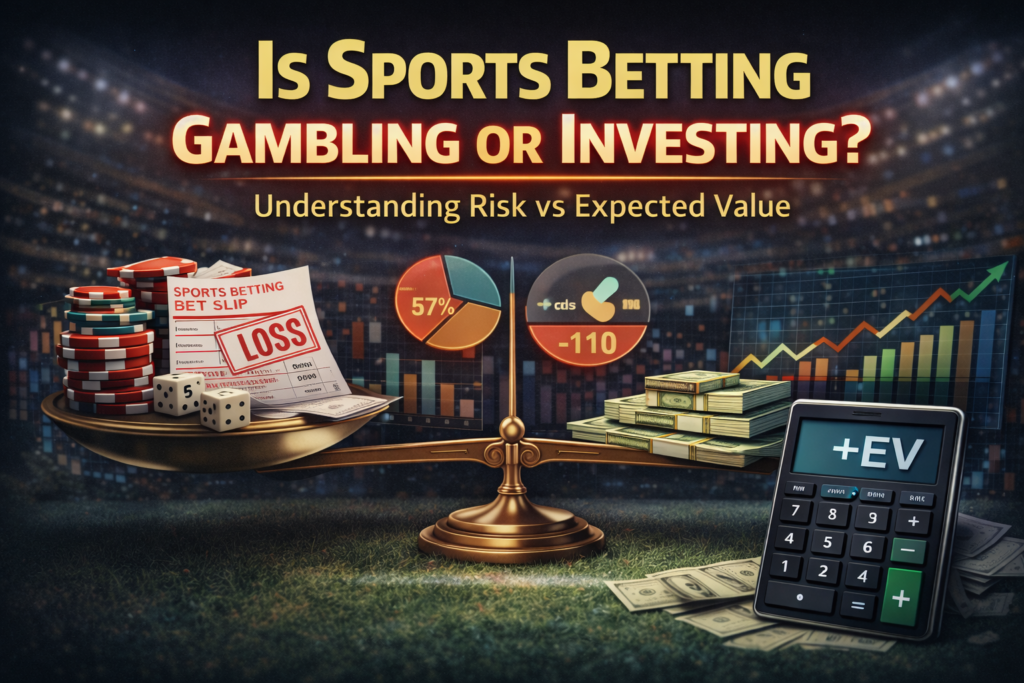
Why Most Sports Betting Is Gambling
For the majority of bettors, the process looks like this:
They watch games.
They follow narratives.
They trust instinct.
They bet based on confidence.
There is rarely any structured probability estimation involved.
Gambling behavior in sports betting typically includes:
- Betting based on who “should win”
- Chasing losses after bad days
- Increasing stake size during hot streaks
- Playing parlays for excitement
- Ignoring implied probability
This approach relies on emotion, not mathematics. And emotion does not beat markets long term.
Without a measurable edge, sports betting defaults to gambling because the sportsbook’s margin ensures long-term negative expectation.
When Sports Betting Becomes Investing
Sports betting begins to resemble investing when it is treated as a probability market.
That means:
- Evaluating implied probability
- Estimating true probability
- Identifying mispriced odds
- Calculating expected value
- Managing bankroll systematically
- Thinking in long-term samples
At that point, the bettor is no longer asking, “Who will win?” They are asking, “Is this price wrong?” That shift changes everything.
The Key Difference: Expected Value
Investing requires positive expected return. Sports betting is no different. If a wager has positive expected value (+EV), it generates profit over the long run even if individual bets lose.
Example:
- Odds: -110
- Break-even rate: 52.38%
- Your estimated probability: 57%
That difference creates edge. If repeated consistently, that small edge compounds over hundreds of bets. Without positive expected value, sports betting is mathematically gambling.
If you need a deeper breakdown, see What Is Expected Value (EV) and Why It Matters in Betting?
Risk Management: The Investing Principle Most Bettors Ignore
Investors diversify. They size positions carefully. They protect capital. Gamblers overexpose.
The same applies to betting.
Even with a measurable edge, poor bankroll management can destroy long-term profitability. Betting 20% of your bankroll on a single game is gambling behavior regardless of your confidence.
Investing-style betting means:
- Fixed percentage staking
- Scaling bets relative to edge size
- Avoiding emotional bet increases
- Tracking long-term ROI
Without risk control, even positive expected value strategies fail.
The Structural Reality: The House Has an Edge
Sportsbooks build margin into every line. At -110 odds, you must win 52.38% just to break even. If you are betting without calculating edge, you are mathematically operating at a disadvantage. That is gambling. To move toward investing behavior, you must consistently identify situations where the true probability exceeds the implied probability. That gap is where profitability lives.
Can Sports Betting Truly Be Investing?
It depends on three conditions.
1. You Have a Quantifiable Edge
You are not guessing.
You are modeling probability.
You can explain why your projection differs from the market.
Platforms like TheOver.ai are built around this principle using structured data modeling to identify statistical mispricing, particularly in totals markets where pace and efficiency projections can diverge from public perception.
The goal is not prediction perfection.
It is probability accuracy.
2. You Think in Large Samples
Investors do not judge a portfolio on one day of returns.
Bettors who operate like investors judge performance over hundreds of wagers.
Short-term results are noise.
Long-term expectation is signal.
3. You Treat Capital as Capital
Investing requires discipline.
Bet sizing must align with edge magnitude. Emotional staking is gambling behavior.
If bankroll volatility controls your decisions, you are not investing you are reacting.
Where the Comparison Breaks Down
Even when treated professionally, sports betting is not identical to investing.
Key differences:
- No long-term intrinsic value accumulation
- Higher variance
- Markets adjust faster
- Edges are thinner
- Capital limitations can occur
Stocks can grow with underlying business value. Sports bets are binary outcomes.
However, from a probabilistic standpoint, the frameworks are similar: price vs value, risk vs return, capital preservation, and long-term expectation.
The Psychology Divide
The real dividing line is psychological.
Gamblers seek excitement.
Investors seek expected return.
Gamblers chase losses.
Investors adjust risk exposure.
Gamblers react emotionally to streaks.
Investors stick to process.
The market does not care which category you fall into. It rewards disciplined probability estimation.
So Which Is It?
For most participants, sports betting is gambling.
For disciplined, mathematically structured bettors with measurable edge and controlled risk exposure, it can resemble investing.
The activity itself is neutral.
Your approach determines the category.
Practical Takeaways
If you want sports betting to function more like investing:
- Always convert odds to implied probability
- Only place bets with positive expected value
- Size wagers responsibly
- Track ROI over large samples
- Accept variance without emotional adjustment
- Focus on price, not prediction
If you do not do those things, the sportsbook’s built-in edge will eventually take over.
Sports betting is not automatically gambling.
But without math, discipline, and structure, it becomes exactly that.