Sportsbooks are businesses that facilitate sports wagering. Unlike bettors, who win when an outcome occurs as they predicted, sportsbooks profit by taking a small cut from every wager placed. Understanding how sportsbooks make money helps bettors grasp why certain bets are priced the way they are and why beating the sportsbook consistently is difficult.
At a fundamental level, sportsbooks make money by managing the odds and balancing risk so that, over time, they collect more in fees and losing bets than they pay out in winnings. Let’s explore how that works.
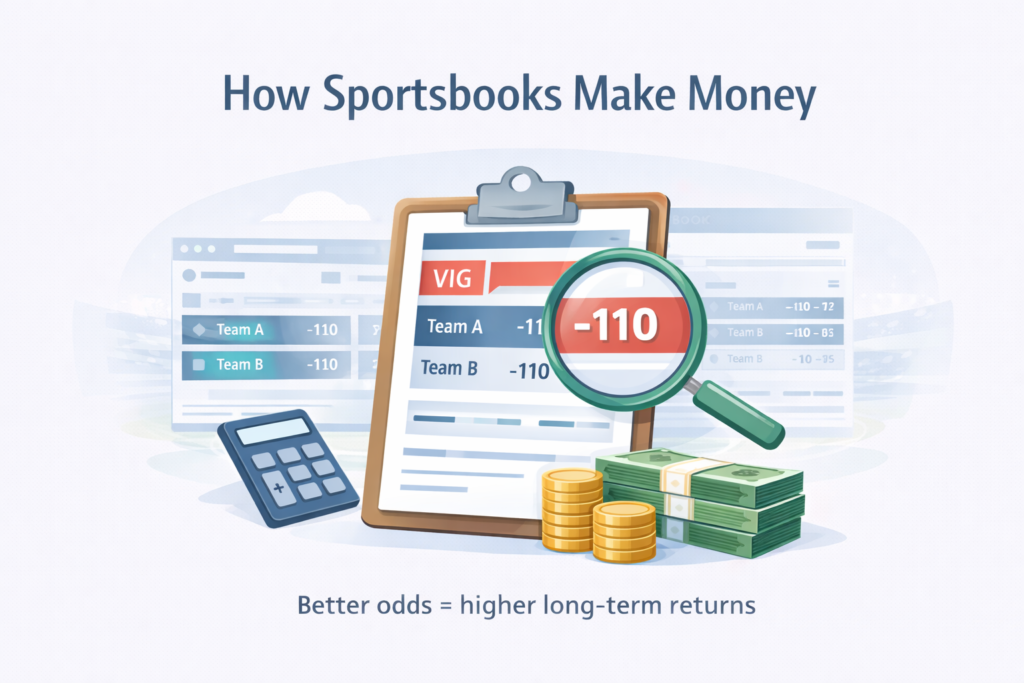
The Vigorish (Vig): The Core Profit Mechanism
The most straightforward way sportsbooks earn revenue is through the vigorish, often called the vig or juice. This is essentially the fee charged by the sportsbook for accepting a bet.
How the Vig Works
When you place a standard bet for example, a point spread or moneyline the odds are rarely set at true 50/50. Instead, the sportsbook will price each side with a slight disadvantage to the bettor.
For example:
- Team A −110
- Team B −110
A fair market with no house edge would pay −100 and −100. The difference between the fair price and these listed odds is the vig.
The vig ensures that if the amount of money wagered on both sides of a contest is balanced, the sportsbook collects profit from the built-in margin regardless of who wins.
Balancing the Book: Risk Management and Line Adjustment
Unlike stock traders or casino dealers, sportsbooks do not try to predict winners. They try to balance action meaning they want roughly equal money on both sides of a bet.
If equal amounts are wagered on both sides, the sportsbook:
- Collects vig on all losing bets
- Makes a profit regardless of the outcome
To achieve balanced action, sportsbooks adjust their lines and odds as money comes in. If too much money is on one side, the line will move to lure bets to the other side and reduce potential exposure.
For example, if many bettors are taking Team A at −3, the sportsbook might adjust the point spread to −3.5 or −4 to discourage further bets on that side and encourage action on the other.
Line Movement and Public Money
Sportsbooks constantly monitor where money is flowing. If most of the betting volume (especially large wagers from respected bettors) is on one side, the odds or line usually shifts toward the opposite side. This keeps risk balanced and protects the sportsbook’s profit margin.
Line movement is not an indicator of certainty about a game’s outcome. Rather, it reflects the market’s betting behavior.
Complex Bets With Higher Margins
Some betting markets generate more profit for sportsbooks than others because they involve higher built-in margins or the sportsbook has more pricing control.
These include:
Parlay Bets
Parlays combine multiple bets into one ticket. All selections must win for the parlay to cash. Because the odds are multiplied across all legs, sportsbooks often price parlays at lower returns than true mathematical odds would suggest. This increases their profit margin.
Same-Game Parlays
Same-game parlays have grown in popularity but typically carry even higher vig than traditional parlays. The interconnected nature of selections and the potential for correlated outcomes gives sportsbooks more margin.
Exotic and Prop Markets
Proposition bets (props), game specials, and niche markets often have less efficient pricing. Books capitalize on this inefficiency by adjusting odds in their favor.
Futures Bets and Capital Efficiency
Futures bets are wagers placed on outcomes that will not be decided until the end of a season or tournament, such as:
- League champions
- Player awards (e.g., MVP)
- Season win totals
Because futures involve unpredictable long-term outcomes, sportsbooks often include larger vig. Additionally, the sportsbook holds bettor capital for an extended period, which increases their profit potential through time value and reduced payout frequency.
Live Betting: Dynamic Pricing for Increased Edge
Live (in-play) betting allows sportsbooks to continually adjust odds as games unfold. Odds are recalculated based on real-time events such as scoring changes, injuries, or momentum shifts. The combination of speed, psychology, and real-time risk balancing often increases the margin in live betting compared with pre-game markets.
How Do Live (In-Play) Bets Work?
Because the sportsbook’s algorithms can adjust instantly, bettors often respond emotionally or impulsively, which gives the bookmaker an additional structural edge.
The Role of Technology and Data
Modern sportsbooks invest heavily in:
- Predictive models
- Real-time data feeds
- Automated risk management systems
- Algorithms that adjust pricing faster than human traders
These technologies help sportsbooks react in milliseconds to changes in betting patterns, ensuring the house maintains its margin.
Behavioral Economics: Bettor Tendencies
Sportsbooks also rely on common bettor behavior patterns to protect and enhance profits. These include:
- Preference for favorites (lower payouts)
- Chasing losses and emotional betting
- Overreliance on public narratives
- Betting parlays instead of singles
Because many bettors do not shop for the best price or discipline their staking, sportsbooks can retain higher margins over the long term.
What Is Line Shopping and Why It’s Important
Promotional Offers: Marketing With a Margin
Sportsbooks offer free bets, bonuses, and odds boosts to attract users. While these offers can provide value to the bettor, they are structured so the sportsbook retains long-term profit through increased wagering volume and higher overall hold.
Key Takeaways
- Sportsbooks make money by embedding a margin (vig) into betting odds.
- Their goal is not to predict winners, but to manage risk and balance action.
- Line movement and odds shifts reflect bettor behavior more than game certainty.
- Complex bets (parlays, futures, props) often carry higher margins.
- Technology and psychology both play a role in the sportsbook’s advantage.