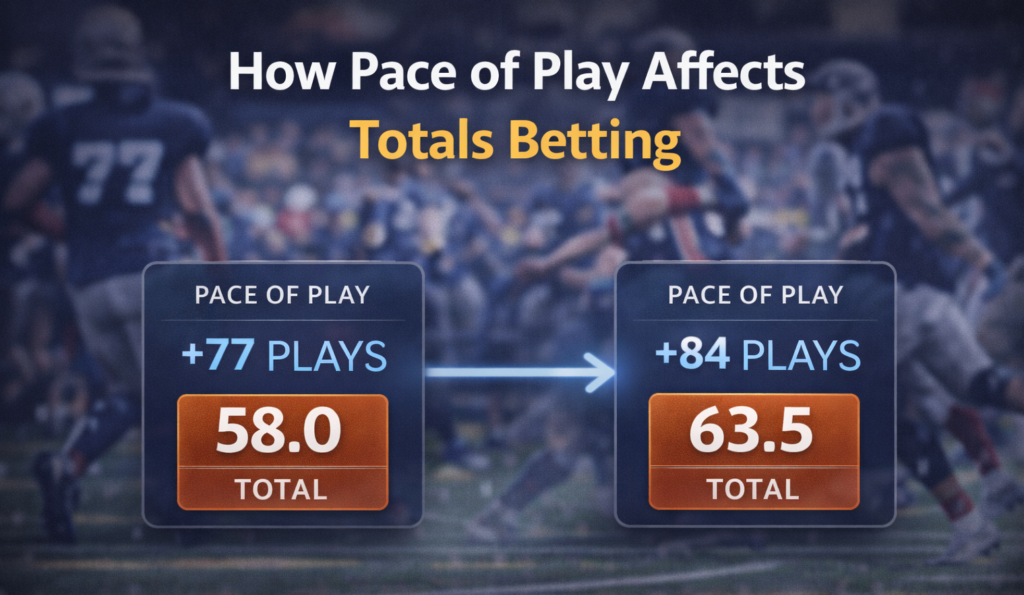
In totals betting, most casual bettors focus on offensive talent. They look at quarterbacks, skill players, or recent scoring trends. However, one of the most important variables in predicting totals is pace of play.
Pace determines opportunity. Opportunity drives volume. Volume influences scoring probability.
Therefore, if you ignore pace, you are ignoring one of the strongest predictors of total points.
Understanding how tempo affects NFL and NCAAF scoring can dramatically improve how you evaluate over and under markets.
What Is Pace of Play?
Pace of play refers to how quickly a team runs offensive plays. In football, this is often measured by:
- Seconds per play
- Total plays per game
- No huddle usage
- Time between snaps
Faster teams generate more possessions. More possessions create more scoring opportunities. As a result, games involving high tempo offenses often produce higher totals.
However, pace is not just about speed. It is about combined tempo. One fast team does not guarantee a fast game. Both teams influence overall play volume.
According to data tracked by resources such as Pro Football Reference, teams that rank in the top third of the league in plays per game consistently produce higher average totals than slow paced teams.
Therefore, pace acts as a multiplier for offensive efficiency.
Why Pace Matters More Than Raw Offensive Rankings
A team can rank high in points per game but still play slowly. In that case, scoring efficiency is strong, but total volume may be limited.
Conversely, a fast paced team with average efficiency may still produce high scoring games because volume compensates for lower per play output.
For example:
- Team A averages 6.2 yards per play but runs only 58 plays per game
- Team B averages 5.6 yards per play but runs 72 plays per game
Team B may produce more total scoring because of increased opportunities.
Therefore, tempo often matters more than highlight offensive metrics.
If you want to understand how scoring probability translates into value, review What Is Expected Value and Why It Matters in Betting.
Combined Pace and Game Environment
Totals depend on combined pace. If one team plays fast but the other consistently slows the game down, tempo may balance out.
However, when both teams operate quickly, possession counts rise significantly.
High tempo matchups typically show:
- More drives
- More third down attempts
- Increased red zone opportunities
- Higher total snap count
As possessions increase, variance increases as well. That often benefits overs.
Still, tempo alone does not guarantee over value. Efficiency must align with volume.
Pace in NFL vs NCAAF
Pace impacts college football totals even more than the NFL.
College teams often use no huddle offenses aggressively. Some programs consistently rank among the fastest in the country. In those games, total play counts can exceed 160 combined snaps.
In contrast, the NFL operates at a more consistent tempo league wide. Therefore, pace differences are smaller but still meaningful.
Because talent disparities are greater in NCAAF, fast paced mismatches can inflate totals rapidly.
Understanding conference tendencies and coaching philosophy becomes critical at the college level.
How Sportsbooks Price Pace
Sportsbooks incorporate pace into opening totals. However, markets do not always adjust perfectly.
If a team changes offensive coordinators or shifts to a faster scheme, early season totals may lag behind new tempo reality.
Similarly, injuries that impact play calling can alter pace without immediate adjustment.
For example:
- Backup quarterbacks may slow tempo
- Defensive injuries may force quicker offensive responses
- Game script expectations may shift snap count projections
Therefore, monitoring pace trends weekly is essential.
If you are unfamiliar with how lines adjust to new information, review What Is Line Movement and Why Should Bettors Care?
Pace and Weather Interaction
Pace also interacts with external factors.
In strong wind games, teams often slow down and rely on rushing attempts. That reduces clock stoppages and overall play volume.
Therefore, pace analysis must consider environment.
If you have not explored that relationship, see How Weather Affects NFL and NCAAF Betting because weather can directly alter tempo expectations.
Using Pace to Find Betting Edge
Pace creates opportunity when markets underweight its impact.
For example:
- Two fast teams with efficient offenses
- A high tempo underdog facing a defense that struggles against hurry up attacks
- Late season games where playoff urgency increases snap volume
In these cases, projected play counts may exceed market assumptions.
Structured modeling becomes especially valuable here. Platforms such as https://www.theover.ai/ focus on tempo and efficiency projections in totals markets. By combining pace with yards per play, red zone efficiency, and situational adjustments, scoring projections become more precise.
However, pace alone does not create edge. Edge exists only when projected total differs meaningfully from implied probability.
For deeper understanding, see What Is an Edge in Sports Betting?
Common Mistakes Bettors Make With Pace
Many bettors misuse pace data. Common errors include:
- Looking only at one team’s tempo
- Ignoring defensive impact on snap count
- Overreacting to one game sample
- Ignoring coaching adjustments
Pace must be evaluated over meaningful sample sizes.
Additionally, game script matters. If a team jumps ahead early, tempo may slow dramatically.
Therefore, projected competitiveness influences expected play volume.
The Relationship Between Pace and Variance
Higher pace increases variance. More possessions create more scoring swings. As a result, totals in fast games may fluctuate more dramatically.
This increased volatility can benefit overs, but it can also increase unpredictability.
Understanding variance helps manage bankroll appropriately. If you have not reviewed that concept, see What Is Variance and How Does It Affect Bettors?
Pace expands opportunity. Variance expands unpredictability.
Final Thoughts
Pace of play affects totals betting because it controls opportunity. More plays mean more scoring chances. More possessions increase potential points.
However, pace must be analyzed in combination with efficiency, weather, coaching tendencies, and matchup context.
Sportsbooks account for tempo, but they do not always adjust perfectly to scheme changes or evolving trends.
Ultimately, pace influences volume. Volume influences scoring probability. Probability determines value.