Injuries are one of the most powerful drivers of betting line movement. While weather, public perception, and sharp money all influence pricing, player availability can shift probability faster than almost any other variable.
However, the impact is rarely as simple as “star player out, line moves three points.”
In reality, sportsbooks adjust based on role, depth, matchup, and market reaction. Therefore, understanding how injuries truly affect betting lines requires more than reacting to headlines.
Why Injuries Matter to Sportsbooks
Sportsbooks price games based on expected performance. When a player is ruled out, that expectation changes. As a result, implied probability must adjust.
For example, if a starting quarterback is ruled out in the NFL, offensive efficiency projections decline. Consequently, both the point spread and the total may move.
However, the size of the adjustment depends on context:
- How valuable is the player relative to replacement?
- Does the team have depth?
- Is the system adaptable?
- How does the opponent match up?
Sportsbooks do not guess. They use models to estimate the difference in win probability.
According to historical betting market research from sources such as the MIT Sloan Sports Analytics Conference, quarterback injuries in the NFL can shift spreads by anywhere from 2 to 7 points depending on tier and backup quality.
That range highlights how role and depth matter more than name recognition alone.
Point Spread Movement After Injury News
When a major injury is announced, spreads typically adjust quickly. However, timing plays a major role.
If injury news breaks early in the week, sportsbooks move cautiously at first. Then, as sharper bettors react, the number stabilizes.
For example:
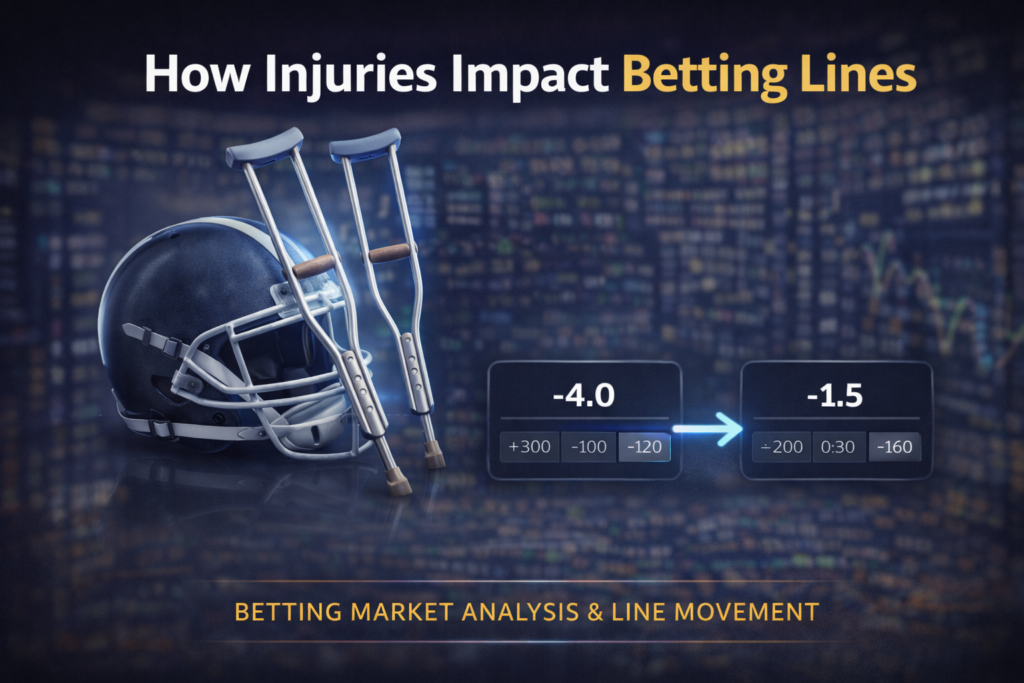
- Team A opens at minus 4
- Starting quarterback ruled out
- Line moves to minus 1.5
This adjustment reflects a change in projected margin of victory. However, the move is rarely purely emotional. It reflects model recalibration plus market reaction.
If you want to understand this process more deeply, review What Is Line Movement and Why Should Bettors Care? because injuries often trigger the most meaningful line shifts.
How Injuries Impact Totals
Injuries do not only affect spreads. They also influence totals.
For example:
- A defensive star ruled out may increase projected scoring.
- An offensive lineman injury may reduce offensive efficiency.
- Multiple skill position injuries may slow pace and lower total points.
Totals markets react based on expected scoring environment. However, totals adjustments are sometimes slower than spread adjustments. That creates potential inefficiencies.
Because pace and efficiency drive scoring projections, structured modeling becomes especially important. Platforms like Theover.ai focus on projecting totals by analyzing tempo, efficiency, and matchup dynamics. When injury adjustments are mispriced in totals markets, probability gaps can appear.
However, those gaps must be verified through proper expected value calculation.
The Difference Between Immediate and Delayed Line Movement
Injuries influence lines differently depending on when they become public.
There are generally three scenarios:
- Injury announced before market open
- Injury announced after open but before heavy betting
- Injury announced close to game time
When news breaks before open, sportsbooks price it immediately. When it breaks later, the market adjusts in stages.
Sometimes, public bettors overreact to headline injuries. Meanwhile, sharper bettors evaluate actual impact more calmly.
Therefore, not every injury-driven line move reflects true probability change. Sometimes it reflects sentiment.
Understanding market efficiency is important here. If you have not reviewed it, see What Is Market Efficiency in Sports Betting? because markets can overcorrect before stabilizing.
Star Power vs Real Impact
One of the biggest betting mistakes involves confusing popularity with value.
Public bettors often assume that losing a well-known player automatically makes a team significantly worse. However, sportsbooks care more about measurable impact.
For example:
- A star wide receiver may move a line one point.
- A starting left tackle may move a line half a point.
- A backup offensive lineman cluster injury may matter more than one skill player.
In the NBA, a high-usage player might shift a spread 3 to 5 points. However, bench depth and rotational flexibility reduce that impact.
Therefore, context always matters more than name value.
How Sharp Bettors React to Injury News
Sharp bettors move quickly when injury information creates mispricing.
If sportsbooks under-adjust, sharp money pushes the line rapidly. If sportsbooks over-adjust, sharp money may take the inflated price on the opposite side.
This is where reverse line movement sometimes appears. If most tickets react emotionally to an injury, but the line stabilizes or moves against the public side, sharper money may disagree with the narrative.
Injuries create volatility. Volatility creates opportunity for those who understand probability.
Injury Impact in Player Prop Markets
Player props often adjust slower than spreads.
For example, if a starting running back is ruled out:
- Backup rushing attempts increase
- Passing volume may rise
- Offensive pace may change
However, sportsbooks may not adjust every correlated prop instantly.
That is why correlated analysis becomes important. When one injury influences multiple statistical outputs, props and totals can diverge temporarily.
Still, value only exists if implied probability differs from projected probability.
See What Is an Edge in Sports Betting? for a deeper explanation of how to quantify that difference.
The Role of Depth Charts and Replacement Value
Injuries matter less when replacement value is strong.
Teams with deep rosters absorb losses better. Teams built around one star suffer more.
For example:
- A quarterback dependent offense collapses without its starter.
- A committee-based rushing offense absorbs injury more smoothly.
- A defense built on scheme may survive individual injuries better than a star-driven defense.
Therefore, modeling replacement impact is critical. This is why probability modeling, rather than emotional reaction, drives profitable injury evaluation.
Common Mistakes Bettors Make With Injuries
Many bettors mishandle injury news. Common errors include:
- Betting immediately without evaluating adjustment size
- Assuming public reaction equals value
- Ignoring correlated totals and props
- Failing to compare new line to implied probability
Injuries do not automatically create edge. They create movement.
Edge only exists if the new price misrepresents probability.
Final Thoughts
Injuries impact betting lines because they change projected performance. However, the magnitude of movement depends on role, depth, timing, and market reaction.
Spreads adjust based on win probability shifts. Totals adjust based on scoring projections. Props adjust based on usage and opportunity.
However, markets can underreact or overreact. That is where structured probability modeling becomes essential.
In the end, injury news is information. Information moves prices. But only probability determines value.