In this article
- What Is Home Court Advantage?
- How Sportsbooks Price Home Court Advantage
- Neutral Court Comparison
- Factors That Change Home Court Value
- Altitude
- Travel Schedules
- Crowd Intensity
- Officiating Trends
- Home Court in Totals Betting
- Has Home Court Advantage Declined?
- When Home Court May Be Overpriced
- When Home Court Is Undervalued
- Home Court in Playoffs vs Regular Season
- Common Mistakes Bettors Make
- Final Thoughts
Home court advantage is one of the oldest concepts in sports betting. However, many bettors misunderstand how it is actually incorporated into betting lines.
Most people assume sportsbooks simply “add a few points” to the home team. In reality, pricing home court advantage is more nuanced. It varies by league, team, altitude, travel schedule, and even officiating tendencies.
Therefore, understanding how home court is quantified helps bettors evaluate whether a number reflects true probability or historical assumption.
What Is Home Court Advantage?
Home court advantage refers to the measurable edge a team gains when playing in its own arena. Historically, home teams win more often than road teams. According to long term NBA data tracked by Basketball Reference, home teams have won roughly 58 to 60 percent of games across multiple seasons.
That advantage stems from several factors:
- Familiar shooting background
- Crowd influence
- Reduced travel fatigue
- Officiating bias toward home teams
- Routine and comfort
However, while the advantage exists, its magnitude fluctuates.
How Sportsbooks Price Home Court Advantage
Sportsbooks incorporate home court advantage directly into the point spread.
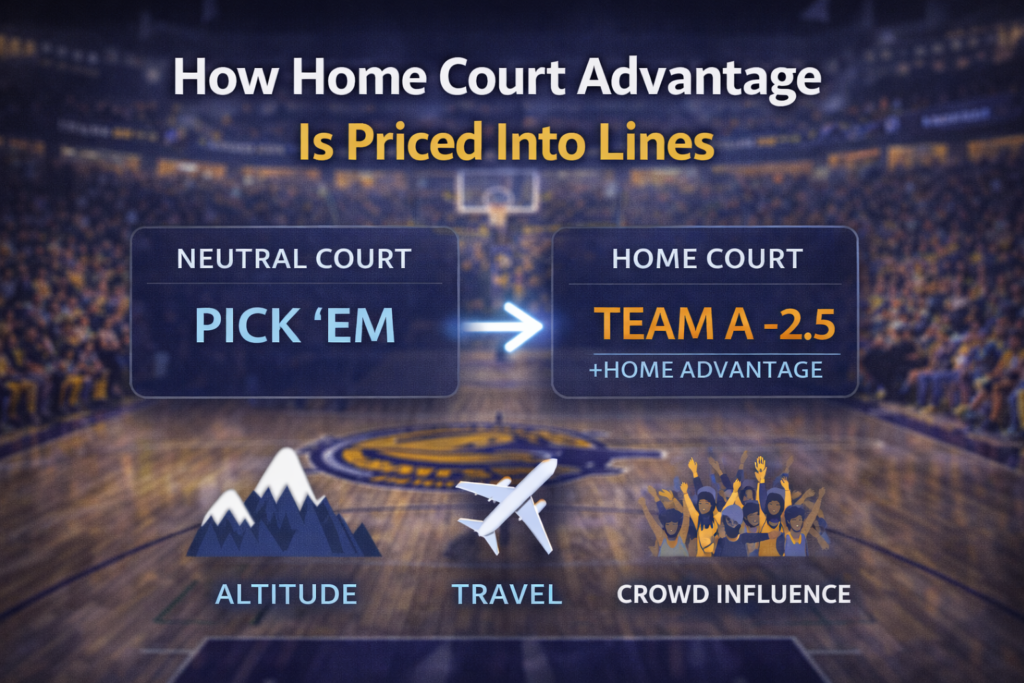
In the NBA, traditional home court value has historically ranged between 2 and 3 points. For example, if two teams are considered equal on a neutral floor, the home team may open as a 2.5 point favorite.
However, this number is not fixed.
Modern analytics show that league wide home advantage has slightly declined over the past decade. Increased travel comfort and improved officiating transparency have narrowed the gap.
Therefore, sportsbooks now adjust home court value dynamically rather than applying a flat number.
Neutral Court Comparison
To understand pricing, consider this simplified example.
If Team A and Team B are evenly matched on a neutral floor, the line would be pick em. However, if Team A is at home, sportsbooks may price the game at Team A minus 2.
That adjustment represents expected home court value.
If you remove that value mentally, you can evaluate the true strength difference between teams.
Understanding this process is essential when comparing spreads across locations.
If you are unfamiliar with how spreads function generally, review What Is a Point Spread and Why Does It Exist?
Factors That Change Home Court Value
Home court advantage is not equal for all teams. Several variables influence its magnitude.
Altitude
Teams like Denver historically show stronger home performance due to elevation. Visiting teams fatigue more quickly. As a result, sportsbooks often price slightly higher home adjustments in altitude environments.
Travel Schedules
Back to back road games reduce performance. Cross country travel compounds fatigue. Therefore, home teams facing tired opponents may receive stronger adjustments.
Crowd Intensity
Playoff environments increase home impact. Louder arenas can affect communication and officiating perception.
Officiating Trends
Research has shown mild officiating bias toward home teams in close games. While this effect has declined over time, it still exists in marginal form.
However, sportsbooks incorporate these variables into broader power ratings rather than isolating them individually.
Home Court in Totals Betting
Home court does not only affect spreads. It can also influence totals.
For example:
- Teams often shoot better at home
- Role players perform more consistently
- Pace may increase in energized environments
However, totals markets are more influenced by pace and efficiency than by location alone.
Platforms such as https://www.theover.ai/ project scoring environments primarily through tempo and offensive efficiency modeling. Home court becomes a secondary adjustment layered onto those projections.
Ultimately, possession volume and efficiency drive totals more than venue alone.
If you want deeper context on scoring projection, see How Pace of Play Affects Totals Betting.
Has Home Court Advantage Declined?
Recent NBA data suggests home court advantage has slightly decreased compared to earlier decades.
Several factors contribute to this trend:
- Improved travel logistics
- League wide shooting consistency
- Reduced crowd influence during certain seasons
- Greater familiarity with opponent arenas
As a result, sportsbooks continuously recalibrate how much weight they assign to home teams.
Therefore, assuming a fixed three point boost is outdated.
Understanding market efficiency is important here. If you need background, review What Is Market Efficiency in Sports Betting?
When Home Court May Be Overpriced
Sometimes public perception inflates home value.
For example:
- High profile teams may attract public home money
- Rivalry games may create emotional bias
- Recent home winning streaks may distort perception
If sportsbooks shade the number slightly due to expected public action, value may exist on the road side.
However, identifying that requires comparing implied probability to realistic projections.
For deeper understanding, review What Is an Edge in Sports Betting?
When Home Court Is Undervalued
In contrast, unique environments may justify stronger home adjustments.
Examples include:
- High altitude arenas
- Extreme travel disadvantages
- Playoff elimination scenarios
- Young teams with strong crowd dependency
In these situations, standard home court assumptions may underestimate impact.
However, context always matters more than narrative.
Home Court in Playoffs vs Regular Season
Playoff home advantage tends to increase slightly. Crowd intensity rises. Rotations tighten. Travel becomes more structured.
However, playoff series also reduce unfamiliarity. Teams see the same opponent repeatedly, which can neutralize certain advantages.
Therefore, sportsbooks adjust home value slightly but not dramatically in postseason pricing.
Common Mistakes Bettors Make
Many bettors misinterpret home court pricing. Common errors include:
- Assuming every home team receives identical value
- Ignoring travel fatigue variables
- Overvaluing crowd narrative
- Failing to compare neutral court projections
Home court is built into the line. It is not extra value unless mispriced.
Final Thoughts
Home court advantage is a real and measurable factor in sports betting. However, it is already embedded into point spreads and totals.
Sportsbooks adjust home value dynamically based on league trends, team specific variables, altitude, travel, and market perception.
Therefore, profitable betting requires understanding how much home court is worth in each specific matchup rather than assuming a fixed adjustment.
In the end, location influences probability. Probability determines price. Price determines value.