Predicting sports outcomes has always been a blend of instinct, statistics, and experience. But in recent years, artificial intelligence (AI) has fundamentally changed how predictions are made moving the process from intuition-driven guesses to data-backed probability modeling.
Today, AI doesn’t try to “guess” winners. Instead, it answers a more powerful question:
What is the true probability of each outcome and is the market pricing it correctly?
This article explains how AI predicts sports outcomes, the models and data behind it, real-world examples, limitations, and how platforms like TheOver.ai apply AI to help bettors and analysts make smarter decisions.
What Does “AI Sports Prediction” Actually Mean?
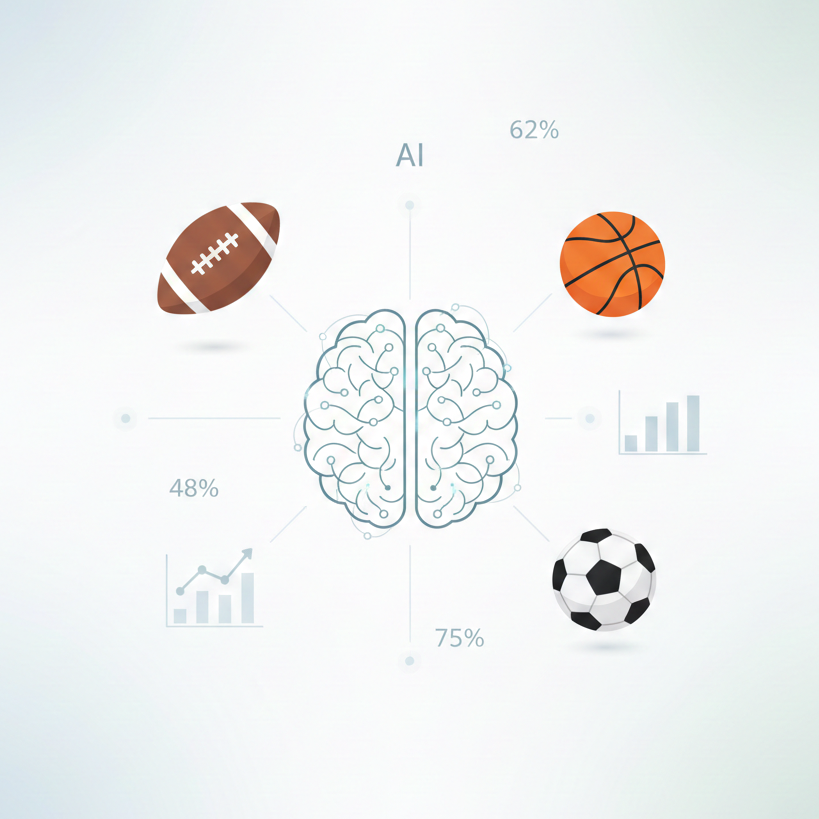
AI in sports prediction refers to machine learning systems trained on massive historical and real-time datasets to estimate probabilities for future events.
Unlike traditional analysis (win–loss records, basic stats), AI models:
- Learn patterns humans can’t easily see
- Continuously update predictions as new data arrives
- Focus on probability, not certainty
For example:
- Instead of saying “Team A will win”, AI outputs:
- Team A win probability: 57.3%
- Market-implied probability: 52.4%
- Potential value detected
This probability-first approach is the foundation of modern predictive sports analytics.
The Core Data AI Uses to Predict Sports Outcomes
AI models are only as good as the data they consume. Advanced sports prediction systems analyze thousands of variables, including:
Historical Performance Data
- Team results across seasons
- Head-to-head matchups
- Home vs away performance
- Rest days and travel schedules
Player-Level Metrics
- Advanced efficiency stats (xG, PER, usage rate)
- Injury impact modeling
- Minutes projections
- Matchup-specific performance
Market & Odds Data
- Opening lines vs closing lines
- Sharp vs public betting behavior
- Line movement velocity
- Odds discrepancies across sportsbooks
Contextual & Situational Data
- Weather conditions
- Referee tendencies
- Schedule congestion
- Motivation factors (playoffs, relegation, tanking)
AI doesn’t treat these as isolated inputs it learns how they interact with each other.
How Machine Learning Models Actually Work in Sports
Different AI models serve different purposes. The most effective platforms combine multiple model types.
Regression Models
Used to estimate:
- Final scores
- Point margins
- Totals (over/under)
Classification Models
Used to predict:
- Win/loss outcomes
- Cover vs no-cover
- Prop outcomes (yes/no)
Neural Networks
Best for:
- Non-linear patterns
- Complex player interactions
- High-dimensional datasets (tracking data)
Ensemble Models
Modern platforms rarely rely on a single model. Instead, they blend multiple models to reduce error and volatility.
This ensemble approach is what separates serious AI prediction tools from basic stat calculators.
From Prediction to Value: Why Probability Matters More Than Picks
AI predictions are useless without pricing comparison.
A 60% win probability means nothing if the sportsbook odds already imply 60%.
This is where Expected Value (EV) becomes central.
AI systems:
- Calculate true probability
- Convert odds into implied probability
- Compare the two
- Flag positive-EV opportunities
Example:
- AI probability: 55%
- Market implied probability: 48%
- Result: Value edge detected
Platforms like TheOver.ai focus heavily on this probability vs price gap, which is how long-term profitable betting actually works.
AI and Totals (Over/Under) Prediction
Totals markets are especially suited for AI because:
- Scores follow statistical distributions
- Pace and efficiency are measurable
- Variance can be modeled
AI evaluates:
- Offensive/defensive efficiency
- Game tempo
- Player usage changes
- Historical total deviations
This allows AI to project realistic scoring ranges, not just single numbers making totals prediction one of AI’s strongest use cases.
Player Props: Where AI Often Has the Biggest Edge
Player props generate massive data but receive less efficient pricing from sportsbooks.
AI excels here by modeling:
- Role changes
- Matchup-specific usage
- Correlation between props
- Coaching tendencies
Because public betting often relies on star names and recent performances, AI-driven prop modeling frequently identifies mispriced lines before they adjust.
Real-World Example: How AI Adjusts a Prediction Live
Imagine a football match:
- Starting striker ruled out 45 minutes before kickoff
- Weather shifts to heavy rain
- Line moves slightly but not enough
An AI system instantly recalculates:
- Shot volume expectations
- Conversion efficiency
- Pace reduction
- Total goals distribution
This real-time adaptability is nearly impossible for humans to replicate consistently.
How TheOver.ai Uses AI Differently
While many platforms stop at predictions, TheOver.ai emphasizes decision-quality analysis:
- Focus on totals, props, and pricing inefficiencies
- Emphasis on data-driven probability modeling
- Clean, bettor-focused presentation
- Designed to support long-term, process-based betting
Instead of hype or “lock” language, the platform aligns with professional betting principles probability, value, and discipline.
The Limits of AI in Sports Prediction (Important to Understand)
AI is powerful but not magic.
Limitations include:
- Black swan events (red cards, freak injuries)
- Small sample sizes
- Late-breaking news
- Psychological factors not yet quantifiable
This is why AI should be used as a decision-support system, not a replacement for judgment or bankroll discipline.