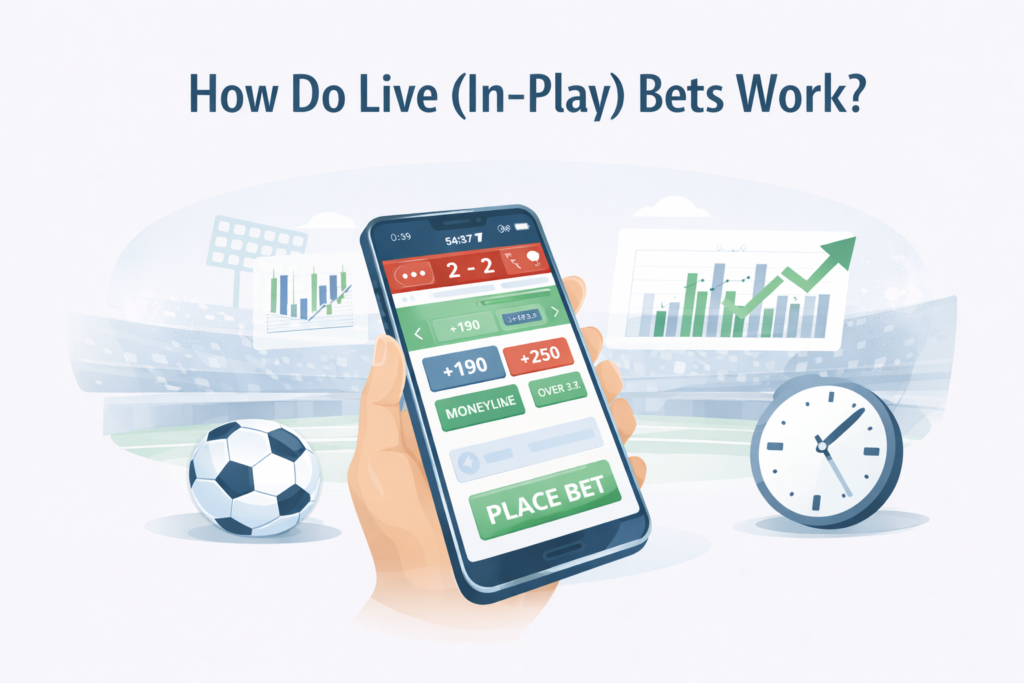
Live betting also known as in-play betting allows bettors to place wagers after a sporting event has already started. Unlike traditional pre-match betting, where odds are fixed once the game begins, live betting markets update continuously based on real-time events.
As live betting has grown across sportsbooks worldwide, understanding how it works, how odds are priced, and what risks it introduces has become essential for bettors who want to use it responsibly and strategically.
What Is Live (In-Play) Betting?
Live betting refers to wagering on a sporting event while it is in progress. Bets can be placed at almost any point during the game, depending on the sport and the market offered by the sportsbook.
Common live betting options include:
- Live moneylines
- Live point spreads
- Live totals (over/under)
- Next score or next play markets
- Player performance props during the game
Live betting allows sportsbooks to adjust odds dynamically as new information becomes available, which significantly changes both risk and decision-making compared to pre-game betting.
Reference: Return on Live Betting – Investopedia
https://www.investopedia.com/live-betting-definition-5217206
How Live Betting Odds Are Calculated
Live betting odds are generated using real-time data models that continuously reassess the probability of outcomes as the game unfolds. These models account for factors such as:
- Current score
- Time remaining
- Possession or momentum
- Injuries or substitutions
- Fouls, penalties, or red cards
For example, a team that was a pre-game favorite may become a live underdog if it concedes early. Conversely, an underdog that gains momentum may see its odds shorten rapidly.
Because odds adjust instantly, bettors are often competing against both the sportsbook’s algorithm and other bettors acting at the same time.
Common Live Betting Markets
Live betting expands the number of available markets beyond what is typically offered before the game.
Core Live Markets
- Live moneyline: Who will win the game at this moment
- Live spread: Adjusted point spread based on current score
- Live totals: Updated over/under as scoring changes
Event-Specific Markets
- Next team to score
- Next goal, touchdown, or point
- Outcome of the next period, set, or quarter
These markets are designed to keep bettors engaged throughout the event, rather than limiting wagering to pre-match decisions.
Reference: What Is Live Betting – Esports Insider
https://esportsinsider.com/explainers/what-is-live-betting
Live Betting vs Pre-Game Betting
| Aspect | Live Betting | Pre-Game Betting |
|---|---|---|
| Timing | During the game | Before the game |
| Odds | Continuously changing | Fixed once placed |
| Information | Real-time events | Historical and pre-game data |
| Decision Speed | Very fast | More deliberate |
| Risk Profile | Higher | Lower |
Live betting rewards speed and situational awareness, while pre-game betting favors preparation and long-term modeling.
Why Live Betting Can Be Appealing
Live betting allows bettors to:
- React to momentum shifts not reflected in pre-game lines
- Adjust positions after unexpected events
- Hedge or reduce exposure on earlier bets
- Exploit temporary mispricing caused by fast market movement
For bettors who closely follow the sport, live betting can feel more intuitive than static pre-game markets.
Risks and Challenges of Live Betting
Faster Decisions, Higher Pressure
Live betting often requires decisions within seconds. This increases the risk of impulsive betting and poor price selection.
Higher Bookmaker Margins
Because of rapid odds movement and increased complexity, live markets often carry higher margins than pre-game markets, reducing long-term profitability.
Emotional Bias
Immediate feedback—winning or losing during the game—can lead to chasing losses or overbetting.
These risks are why live betting is frequently associated with higher problem-gambling potential, as noted by Investopedia.
Live Betting and Expected Value
Just like pre-game bets, live bets should be evaluated using expected value (EV) rather than short-term outcomes.
Live betting does not eliminate variance or create automatic edges. Without discipline, it can magnify losses faster than traditional betting.
Using Live Betting Strategically
To use live betting more effectively:
- Focus on sports you understand deeply
- Avoid betting every market just because it is available
- Keep stake sizes smaller than pre-game bets
- Track live bets separately to evaluate performance
How to Track Betting Performance Correctly
Analytics platforms such as TheOver.ai help bettors analyze performance across bet types, including live markets, rather than relying on memory or short-term results.
Conclusion
Live (in-play) betting allows bettors to wager in real time, responding to events as they happen rather than relying solely on pre-game analysis. While it offers flexibility and engagement, it also introduces higher risk, faster decision-making, and increased bookmaker edge.
For most bettors, live betting should be used selectively and strategically not impulsively. When combined with sound bankroll management, performance tracking, and value-based decision-making, it can complement a broader betting approach.
In sports betting, speed should never replace discipline.