If you’re learning sports betting, one of the first things you’ll notice is that odds don’t always look the same. Some sportsbooks use numbers like +150 or -200, while others use 2.50 or 1.80. These are not different bets they are different ways of expressing the same information.
The two most common formats are American odds and Decimal odds. Understanding how they differ and how they express risk, reward, and probability is essential for any bettor who wants to make informed decisions.
This guide breaks down exactly how each format works, how they compare, and which one may be better for you.
What Are American Odds?
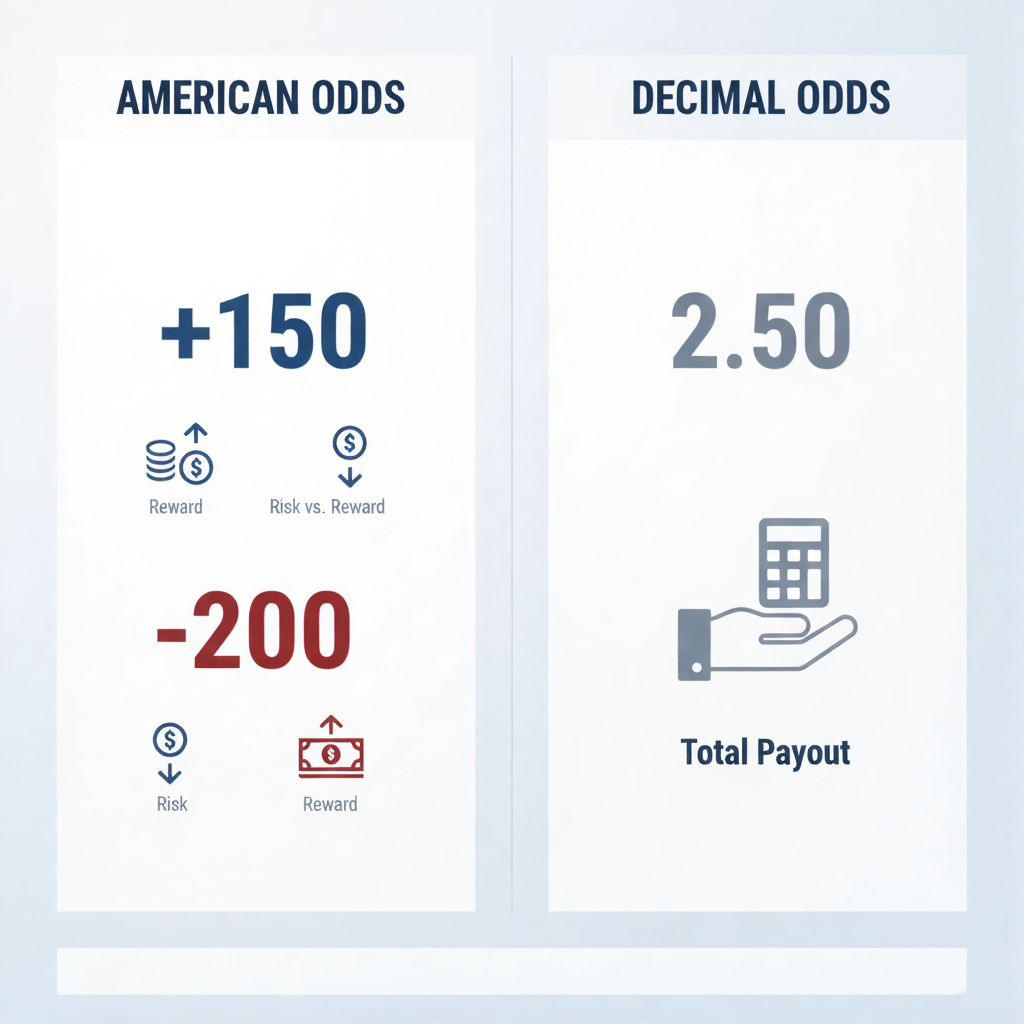
American odds are primarily used in the United States. They use either a positive (+) or negative (-) number to show:
- How much you can win on a $100 bet (positive odds)
- How much you must bet to win $100 (negative odds)
Examples:
- +150 → Bet $100 to win $150 profit
- -200 → Bet $200 to win $100 profit
American odds clearly separate favorites and underdogs, making them popular with bettors who like thinking in terms of risk vs reward.
What Are Decimal Odds?
Decimal odds are used widely in Europe, Australia, Asia, and most international sportsbooks. They show your total payout (stake + profit) for every 1 unit wagered.
Formula:
Total Payout = Stake × Decimal Odds
Example:
- Odds: 2.50
- Stake: $100
- Total payout = $250
- Profit = $150
Decimal odds use one simple number, which makes them intuitive and easy to calculate.
Key Differences Between American Odds and Decimal Odds
Difference in Structure and Format
The most fundamental difference between American odds and decimal odds lies in how each format structures information and guides bettor thinking. American odds revolve around a $100 reference point and use positive (+) and negative (-) numbers to communicate value. Positive odds tell bettors how much profit they can earn on a $100 wager, while negative odds show how much they must risk to win $100. This structure pushes bettors to constantly evaluate bets through the lens of risk versus reward.
Decimal odds take a different approach. They use a single number that always exceeds 1.00, and that number represents the total payout per unit wagered, including the original stake. Bettors do not need to separate profit from stake or think in terms of a fixed dollar reference. Instead, decimal odds focus on the final return. In short, American odds separate stake and profit, while decimal odds combine both into one clear figure.
Difference in How Payouts Are Shown
American odds do not show payouts immediately. Bettors must first determine whether the odds are positive or negative, apply the correct formula, and then calculate profit separately from the stake.
American Odds
- Positive odds: Profit = (Stake × Odds ÷ 100)
- Negative odds: Profit = (Stake × 100 ÷ |Odds|)
Example:
- +150 with $50 stake → Profit = 50 × 150 ÷ 100 = $75
- -200 with $50 stake → Profit = 50 × 100 ÷ 200 = $25
Total payout = Profit + Stake
Decimal odds display payouts with instant clarity. Bettors simply multiply their stake by the odds to calculate the total return. The same formula applies to every bet, regardless of whether the selection is a favorite or an underdog.
Decimal Odds
- Total payout = Stake × Decimal Odds
- Profit = Total Payout − Stake
Example:
- 2.50 with $50 stake → Total payout = 50 × 2.5 = $125
- Profit = 125 − 50 = $75
Difference in Mental Framing and Psychology
The two odds formats shape bettor psychology in different ways. American odds encourage risk-focused thinking by highlighting how much money a bettor must risk relative to potential profit. This framing naturally leads bettors to question whether backing a heavy favorite makes sense given the limited return.
Decimal odds shift attention toward the outcome instead of the risk. Bettors see exactly how much they will receive if the bet wins, which makes the process feel simpler and more intuitive. This outcome-first framing reduces intimidation and lowers the mental barrier for newer bettors. In essence, American odds emphasize exposure, while decimal odds emphasize reward.
Difference in Identifying Favorites and Underdogs
American odds make it easy to identify favorites and underdogs at a glance. Negative numbers immediately signal favorites, while positive numbers identify underdogs. The plus or minus sign alone communicates market expectations without requiring additional interpretation.
Decimal odds require bettors to understand numerical context. Odds below 2.00 indicate favorites, while odds above 2.00 signal underdogs. Although this system remains logical, it relies on numerical comparison rather than instant visual cues. American odds communicate relative strength more directly, while decimal odds depend on familiarity with the scale.
Difference in Implied Probability Calculation
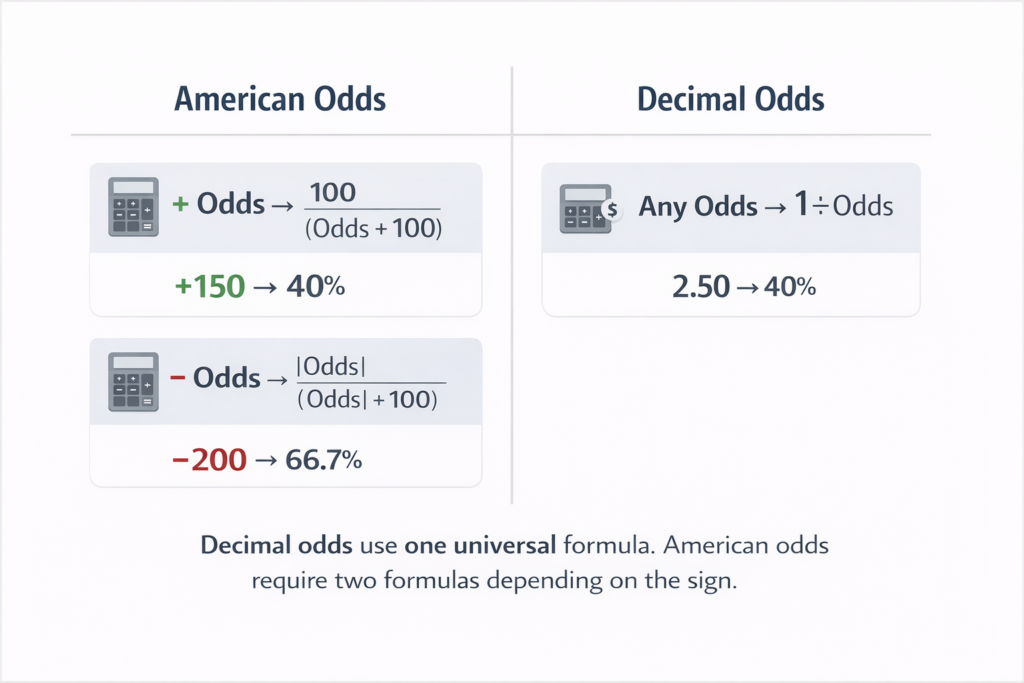
American odds complicate implied probability calculations by requiring two separate formulas, depending on whether the odds are positive or negative. This complexity increases the likelihood of mistakes and slows down analysis for bettors trying to identify value quickly.
Decimal odds simplify probability analysis with a single universal formula: implied probability equals one divided by the decimal odds. This efficiency explains why analysts, professional bettors, and AI-driven platforms often rely on decimal odds internally. American odds add friction to probability conversion, while decimal odds remove it.
Difference in Parlay and Multiple Bet Calculations
The gap between the two formats becomes even more apparent with parlays and multiple bets. American odds force bettors to convert selections into decimal odds or calculate payouts step by step, which slows analysis and increases error risk.
Decimal odds streamline parlay calculations. Bettors multiply all selections together and then multiply the result by their stake to determine the total payout. This efficiency makes decimal odds the clear choice for anyone who regularly places accumulators or analyzes multi-leg bets.
Difference in Global Usage and Standardization
American odds dominate the United States and appear primarily on North American sportsbooks. Their use ties closely to U.S. betting culture and long-standing market practices.
Decimal odds serve as the global standard. Sportsbooks across Europe, Asia, Australia, and international online platforms rely on them. This consistency allows bettors to move between markets without adjusting their calculations. American odds remain region-specific, while decimal odds support global standardization.
Difference in Learning Curve
American odds present a steeper learning curve. Bettors must memorize formulas, understand sign-based logic, and practice calculations before gaining confidence. This complexity often slows adoption for beginners.
Decimal odds remove those barriers. One formula works for every bet, which makes the format easier to explain, easier to teach, and easier to learn. American odds reward experience, while decimal odds prioritize accessibility.
Difference in Analytical and Professional Use
American odds align well with a traditional U.S. betting mindset that prioritizes risk assessment and exposure. Casual bettors often prefer them because they clearly show how much money is at risk.
Decimal odds integrate more naturally into advanced analysis. They fit seamlessly into statistical modeling, expected value calculations, and AI-based betting systems. Because they simplify probability and payout math, sharp bettors and data-driven platforms favor decimal odds for efficiency and precision.
Core Difference at a Glance
| Aspect | American Odds | Decimal Odds |
|---|---|---|
| Format | + / – values | Single number |
| Shows | Risk or profit | Total payout |
| Payout clarity | Requires calculation | Instant |
| Probability conversion | Two formulas | One formula |
| Parlay calculation | Complex | Simple |
| Beginner friendliness | Moderate | High |
| Global use | Limited | Widespread |
| Analytical efficiency | Lower | Higher |
Which Odds Format Is Better?
There is no objectively better format it depends on your goals and experience.
American Odds Are Better If You:
- Bet mostly on U.S. sportsbooks
- Think in terms of favorites and underdogs
- Like seeing risk and reward separated clearly
Decimal Odds Are Better If You:
- Want instant clarity on total payout
- Bet parlays or multiple selections
- Compare odds across international sportsbooks
- Prefer simple math and fast decisions
Many professional bettors understand both and switch formats depending on the situation.
Why Bettors Should Learn Both
Modern betting platforms often allow you to switch odds formats instantly. Understanding both allows you to:
- Avoid confusion when switching sportsbooks
- Spot value regardless of odds format
- Better understand AI-driven betting insights
- Analyze odds faster in live betting situations
Platforms like Theover.ai often convert odds behind the scenes, using probabilities and expected value to help bettors make smarter decisions regardless of how odds are displayed.
Everyday Analogy
Think of odds formats like temperature units:
- American odds = Fahrenheit
- Decimal odds = Celsius
They describe the same reality, just in different languages. Once you understand both, you can interpret betting information anywhere in the world.
Final Thoughts
American odds and decimal odds are two different ways of expressing the same betting truth: risk, reward, and probability.
- American odds highlight how much you win or risk
- Decimal odds highlight how much you get back
Understanding the difference helps you:
- Calculate payouts accurately
- Compare sportsbooks effectively
- Identify value bets
- Become a more confident, informed bettor
If you want to succeed in sports betting especially with modern data-driven tools learning both odds formats is essential.