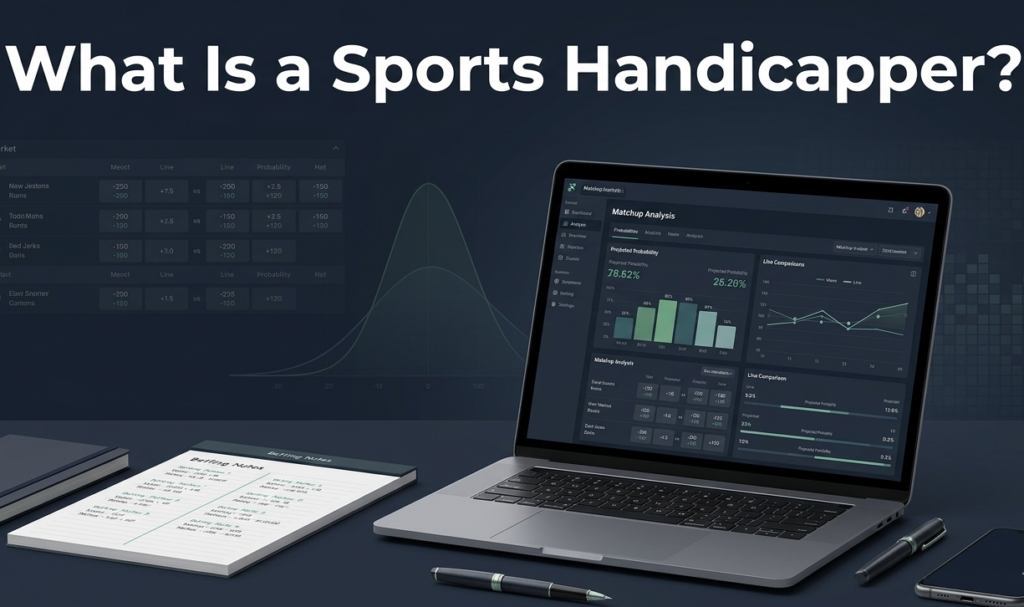
A sports handicapper is someone who analyzes games, betting markets, and probabilities in order to make betting picks. In simple terms, a handicapper studies a matchup and tries to determine whether the sportsbook line is fair or whether one side, total, or prop offers value.
That is the basic definition. However, the term can mean very different things depending on context.
Sometimes it refers to a serious bettor who builds models, studies price movement, and bets with discipline. Other times it refers to a public picks seller, media personality, or content creator who publishes selections for an audience. Those are not necessarily the same thing.
Understanding that difference matters, especially if you are trying to learn from handicappers or decide whether a handicapper is actually worth following.
What a Sports Handicapper Actually Does
At the core, a sports handicapper tries to answer one question: is the market price correct?
That process usually involves studying variables such as:
- Team and player quality
- Injuries and lineup changes
- Pace and efficiency
- Travel and rest
- Matchup style
- Weather
- Recent market movement
- Historical pricing patterns
The goal is not just to predict who will win. The real goal is to compare the handicapper’s own probability estimate to the sportsbook’s implied probability.
That is what makes handicapping different from casual fan opinion. A fan may say, “I think Team A wins.” A handicapper should be asking, “Does Team A win often enough to justify this price?”
What Makes a Good Sports Betting Pick?
Why the Word “Handicapper” Can Be Misleading
The word sounds simple, but it covers a wide range of people.
A handicapper can be:
- A private professional bettor
- A model-driven analyst
- A public picks seller
- A sportsbook market observer
- A media personality offering game breakdowns
That creates confusion because many people assume all handicappers are proven winners. That is not true. Some are skilled analysts. Some are marketers. Some are entertainers. Some are legitimate bettors with a real edge.
This is why you should not judge a handicapper by confidence or presentation style alone. The important question is whether the person has a sound process and whether that process actually beats the market over time.
A Good Handicapper Thinks in Probabilities
A real handicapper should think in terms of probability, not certainty.
That means they do not look at a game and say, “This is a lock.” They look at the line and ask whether the price reflects the true chance of the outcome. For example, if a team is priced at +150, the implied probability is 40 percent. If the handicapper believes the team actually wins 46 percent of the time, that may be a good bet.
That does not mean the bet will win tonight. It means the price may be favorable in the long run.
This is one of the biggest differences between serious handicapping and casual betting talk. Serious handicapping is built around value, not hype.
A natural internal link here is What Is Expected Value and Why It Matters in Betting.
Sports Handicappers Use Different Methods
Not every handicapper works the same way.
Some rely heavily on numbers. Others combine statistical work with film study and matchup context. Some focus on one sport or even one market. Others work more broadly across leagues.
Common approaches include:
- Power ratings
- Pace and efficiency modeling
- Injury adjustments
- Situational analysis
- Historical market research
- Closing line tracking
For example, a totals-focused handicapper may care far more about pace and offensive efficiency than simple win-loss records. That is one reason projection-based tools like TheOver.ai focus on tempo and scoring environment rather than surface level narratives. A serious handicapper wants inputs that improve forecasting, not just stats that sound impressive.
Public Handicapper vs Professional Bettor
This is one of the most important distinctions.
A public handicapper shares picks with an audience. A professional bettor risks their own bankroll to beat the market. Sometimes the same person does both. Often, they do not.
A public handicapper may be judged by:
- How well they explain games
- How entertaining they are
- Whether they publish a transparent record
- Whether their picks are independently tracked
A professional bettor is judged by one thing: long term profitability.
That is why the most famous handicappers are not always the best bettors, and the best bettors are not always public. In fact, many true professionals avoid publicity because public attention makes it harder to maintain an edge.
Who Are the Top Handicappers of All Time?
What Makes a Good Sports Handicapper?
A good sports handicapper usually has a few key traits.
First, they can explain why a line may be off. Second, they focus on price instead of just picking winners. Third, they understand variance and do not overreact to short-term results. Fourth, they track performance honestly.
Most importantly, a good handicapper has a repeatable process. They are not just reacting emotionally to the game of the day. They are applying a framework.
That framework does not need to be overly complicated, but it should be consistent.
Common Misunderstandings About Handicappers
Many new bettors misunderstand what a handicapper is supposed to do.
A handicapper is not someone who guarantees winners. No one can do that consistently in a probability market. A handicapper is also not automatically sharp just because they sound confident or use advanced terminology.
Another common mistake is assuming a winning streak proves expertise. It does not. Short runs can happen because of variance. What matters is whether the handicapper’s process creates value over large samples.
This is where understanding market efficiency becomes important. Sportsbooks are sharp, and obvious errors are rare. That means strong handicapping usually lives in small edges, not giant certainties.
What Is Market Efficiency in Sports Betting?
Should You Follow a Sports Handicapper?
That depends on what you want.
If you are looking to learn, a handicapper can be useful if they explain games clearly and teach you how to think about price, probability, and market behavior.
If you are looking for picks, you should be more careful. The key questions become:
- Is there a transparent record?
- Are the odds tracked honestly?
- Is the process clear?
- Does the handicapper beat the closing line?
- Are the results sustainable over a large sample?
Blindly following picks without understanding the logic is risky. Even a strong handicapper will have losing stretches, and without understanding the process, most followers will not know when variance ends and weak analysis begins.
Final Thoughts
A sports handicapper is someone who analyzes betting markets and games in an attempt to identify value. At the highest level, handicapping is not about making flashy predictions. It is about estimating probability better than the market.
That is why the best handicappers focus on process, pricing, and discipline rather than certainty and hype.
In the end, a handicapper is only as good as the edge behind the picks. And in betting, edge always comes back to one thing: whether the number is wrong.