In sports betting, not all bettors are equal. Some consistently beat the market over time, while others lose steadily despite placing bets almost every day. The difference often comes down to whether a bettor behaves like a sharp or a public bettor.
Understanding the distinction between sharp bettors and public bettors is critical for anyone who wants to improve decision-making, manage risk, and bet with long-term discipline. This article explains what separates the two, how sportsbooks react to them, and how everyday bettors can adopt sharper habits.
What Is a Sharp Bettor?
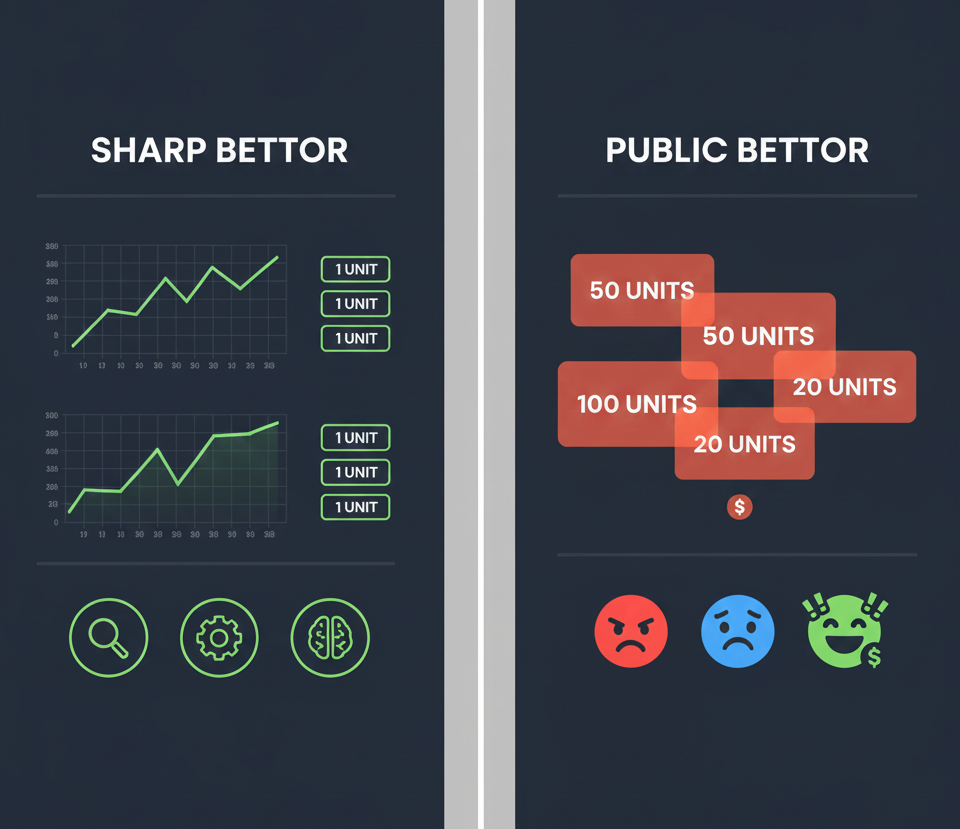
A sharp bettor, sometimes called a professional bettor, is someone who consistently makes bets with positive expected value. Sharps focus on probability, pricing, and long-term edges rather than emotions or entertainment.
Sharp bettors approach betting as an investment activity. They rely on data, market inefficiencies, and disciplined bankroll management rather than opinions or narratives.
Key Characteristics of Sharp Bettors
Sharp bettors typically share several traits.
- They understand probability and value deeply
- They shop for the best odds across sportsbooks
- They bet early when lines are soft
- They wager consistent unit sizes
- They track results over large sample sizes
- They ignore hype, media narratives, and fan bias
Sharps are not defined by how much they win on a single bet. They are defined by how consistently they beat the closing line and generate long-term profit.
What Is a Public Bettor?
A public bettor is a casual or recreational bettor who places wagers primarily for entertainment. Public bettors often bet based on instinct, team loyalty, recent performance, or popular opinion.
Public betting activity tends to cluster around favorites, overs, star players, and nationally televised games. Sportsbooks expect the public to lose over time, which is why betting markets are often shaped around public behavior.
Key Characteristics of Public Bettors
Public bettors commonly:
- Bet based on emotions or fandom
- Overvalue recent results
- Prefer favorites and overs
- Chase losses after bad days
- Increase bet sizes impulsively
- Ignore bankroll structure
This does not mean public bettors are unintelligent. It means they treat betting as entertainment rather than a probability-driven decision-making process.
Sharp Bettor vs Public Bettor: Core Differences
The difference between sharp and public bettors is not about confidence or volume. It is about process.
Decision-Making Approach
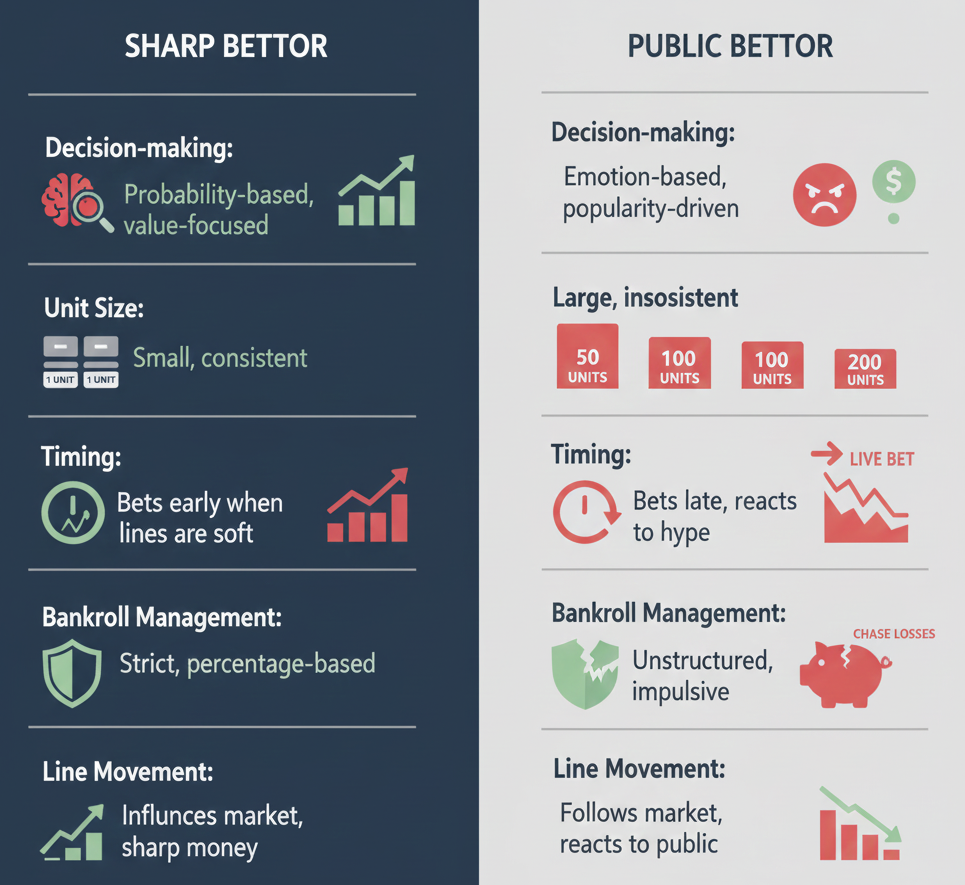
Sharp bettors ask whether the odds reflect true probability. Public bettors ask who they think will win.
Sharps evaluate pricing. Public bettors evaluate outcomes.
For example, a sharp bettor may bet on a team they believe will lose most of the time, as long as the odds underestimate its chances. A public bettor typically avoids such bets entirely.
This distinction is closely tied to understanding expected value, which is explained in detail in What Is Expected Value (EV) and What EV means?, an essential concept for identifying sharp opportunities. And for a broader probability framework, see Investopedia’s guide to expected value and probability concepts, an essential resource for evaluating betting opportunities.
Relationship With Betting Lines
Sharp bettors understand how sportsbooks set lines and why those lines move. Public bettors usually do not.
Sportsbooks adjust odds based on sharp action, not public opinion. When respected bettors place large wagers, sportsbooks respond by moving the line to reduce risk.
This process is explained more deeply in How Do Sportsbooks Set Betting Lines?, which helps clarify why some bets influence the market more than others.
How Sportsbooks Treat Sharp vs Public Bettors
Sportsbooks track betting behavior carefully. Over time, they learn which accounts consistently beat the market.
How Sportsbooks React to Sharp Bettors
Sharp bettors often experience:
- Lower betting limits
- Account restrictions
- Faster line movement after their bets
- Limited access to promotions
Sportsbooks respect sharp money, even when they restrict it. Sharp action signals pricing errors that sportsbooks want to correct quickly.
How Sportsbooks View Public Bettors
Public bettors usually receive:
- Higher betting limits
- Frequent promotions and bonuses
- Less scrutiny
- More marketing offers
Public betting volume is predictable and profitable for sportsbooks. That is why marketing efforts are designed primarily for recreational bettors.
Line Movement and Sharp Money
One of the clearest ways to identify sharp activity is through line movement.
When a betting line moves without significant public betting volume, it often indicates sharp money entering the market. This phenomenon is commonly referred to as sharp line movement.
Understanding line movement allows bettors to see where informed money is going, rather than following public consensus. Platforms like TheOver.ai analyze line movement and market behavior to help bettors identify data-driven signals instead of relying on guesswork.
Betting Timing: Early vs Late
Sharp bettors usually bet early. Public bettors usually bet late.
Early lines are more vulnerable to inefficiencies because sportsbooks have less information and lower betting volume. Sharps attack these numbers before the market corrects.
Public bettors tend to bet close to game time, after consuming media coverage and reacting to narratives.
This difference in timing often explains why sharps consistently beat the closing line, while public bettors do not.
Bankroll Management Differences
Sharp bettors use structured bankroll management. Public bettors often do not.
Sharps bet in units, usually risking a small percentage of their bankroll on each wager. This allows them to survive variance and maintain discipline through losing streaks.
Public bettors frequently increase bet sizes after losses or bet too much on high-confidence games.
If you want to understand why unit-based betting is essential for sharp behavior, What Is Bankroll Management for Sports Betting? provides a clear foundation.
Example: Sharp vs Public Bet on the Same Game
Consider a football game where Team A is favored by seven points.
Public bettors see Team A as dominant and rush to bet the favorite. The spread moves from minus seven to minus eight.
Sharp bettors wait. If the line reaches a number they believe overstates Team A’s advantage, they bet the underdog at plus eight, even if they think Team A is more likely to win.
The sharp bettor is not predicting the winner. They are exploiting price inefficiency.
Can a Public Bettor Become a Sharp Bettor?
Yes, but it requires a mindset shift.
Becoming sharper means:
- Focusing on odds, not teams
- Learning probability and value
- Tracking results honestly
- Using consistent unit sizing
- Avoiding emotional betting
- Studying line movement
Tools like TheOver.ai help bridge the gap by providing analytics, trend tracking, and market insights that reduce emotional bias and improve decision-making.
Common Misconceptions About Sharp Bettors
Many people believe sharp bettors always win. They do not.
Sharps lose regularly, sometimes in long streaks. What separates them is that their losses are controlled and their bets are priced correctly.
Another misconception is that sharps only bet large amounts. In reality, many sharp bettors wager modestly but consistently.
Why Understanding This Difference Matters
Knowing the difference between sharp and public bettors changes how you interpret betting markets.
Instead of asking who will win, you begin asking whether the odds reflect reality. Instead of following the crowd, you learn to recognize when the crowd is wrong.
This perspective is the foundation of long-term betting success.
Conclusion
The difference between a sharp bettor and a public bettor is not luck, confidence, or insider knowledge. It is discipline, probability awareness, and process.
Sharp bettors focus on value, timing, and risk control. Public bettors focus on outcomes, emotions, and entertainment.
By adopting sharper habits and using data-driven tools like TheOver.ai, bettors can move away from reactive betting and toward informed decision-making that holds up over time.