One of the most common questions in sports betting is not “Which team will win?” but “How much should I bet?” Even the most accurate predictions can fail if the amount wagered is poorly managed. Understanding bet sizing is a crucial part of disciplined sports betting and is directly tied to bankroll management, risk control, and long-term profitability.
This article provides a comprehensive guide on how to determine your wager size, factoring in bankroll, odds, confidence, and long-term strategy.

Why Bet Size Matters
Betting too much on a single wager exposes your bankroll to high risk. Conversely, betting too little can reduce growth potential. Proper bet sizing ensures:
- Protection from losing streaks: Even skilled bettors experience variance. Wagering within limits prevents catastrophic loss.
- Consistent long-term growth: Small, calculated bets compound over time, maximizing the value of winning streaks.
- Emotional stability: Predetermined bet sizes prevent impulsive decisions and “chasing losses.”
For example, imagine a bettor with a $1,000 bankroll who places a $500 bet on a favorite at -200. If the bet loses, the bankroll is immediately halved. A $20 bet on the same odds would protect the bankroll and allow continued participation in future bets.
Determining Your Bankroll
Before deciding how much to bet per wager, you need to define your bankroll. A bankroll is the total amount of money allocated for betting purposes and should be separate from daily living expenses or emergency funds.
Example:
If you set aside $2,000 specifically for sports betting, that is your bankroll. Bankroll management principles dictate that a small, fixed percentage of this total is risked per wager.
Unit Size: The Core of Bet Sizing
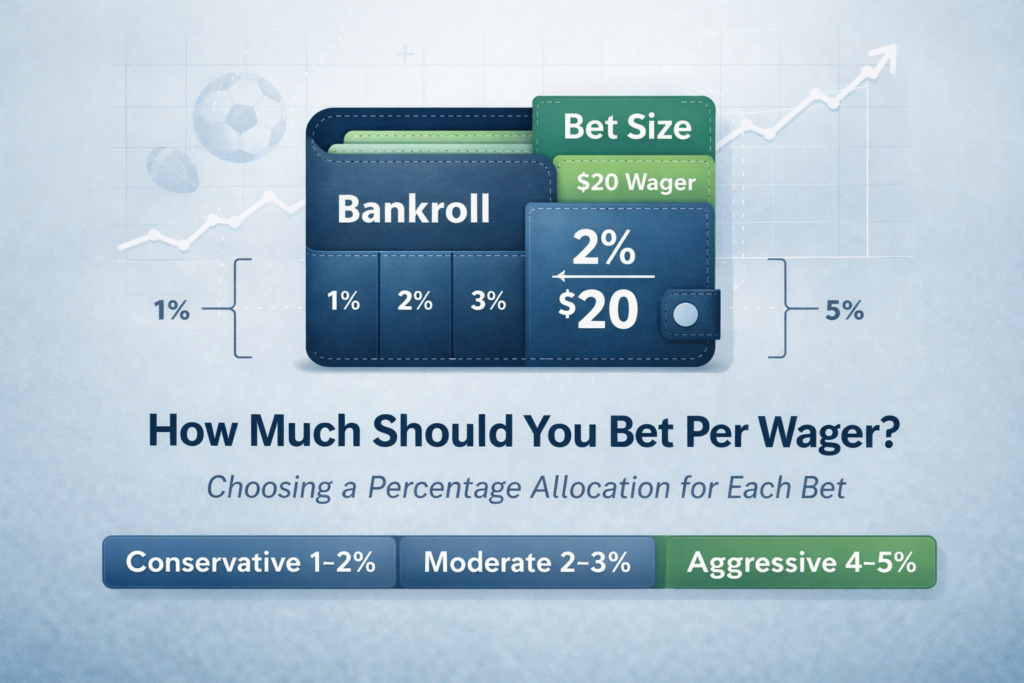
A unit is a standardized portion of your bankroll used to determine wager amounts. Most professional bettors recommend risking 1% to 5% of your bankroll per bet, depending on risk tolerance.
- Conservative approach: 1–2% per bet – prioritizes safety and bankroll survival
- Moderate approach: 2–3% per bet – balances growth and risk
- Aggressive approach: 4–5% per bet – higher potential returns, higher risk
Example:
Bankroll: $1,000
2% per bet → $20 per wager
This method protects your bankroll during losing streaks while allowing growth during winning streaks.
Adjusting Bet Size Based on Confidence
Some bettors use variable unit sizing, adjusting wager size based on the perceived confidence or edge of a bet. While this can maximize returns, it requires an accurate assessment of probabilities.
Example:
- High-confidence bet → 3 units ($60 if 1 unit = $20)
- Moderate-confidence bet → 1 unit ($20)
However, it is important to avoid overestimating confidence.
Using Odds to Determine Bet Size
American or decimal odds also impact bet sizing decisions. Understanding potential payouts relative to stake is essential for calculating risk-reward.
American Odds Example:
- +150 (underdog) → Betting $20 wins $30 profit
- -200 (favorite) → Betting $40 wins $20 profit
Decimal Odds Example:
- 2.50 → Betting $20 returns $50 (including stake)
- 1.50 → Betting $40 returns $60 (including stake)
By combining bankroll percentage and odds, bettors can calculate consistent wager amounts while understanding potential payout.
Risk Tolerance and Losing Streaks
Even with proper unit sizing, variance means losing streaks are inevitable. Adjusting bet size during a losing streak can protect your bankroll.
Example:
- Bankroll: $1,000
- Unit size: 2% → $20 per bet
- Losing 3 bets in a row → bankroll drops to $940
- New 2% unit → $18.80 per bet
This strategy ensures survival and preserves the ability to bet through inevitable variance.
Flat Betting vs. Percentage Betting
Flat Betting:
Wagering the same amount each bet regardless of bankroll or confidence. Simple and effective for beginners.
Percentage Betting:
Adjusting wager size based on bankroll (and sometimes confidence). More sophisticated, allows compounding growth, and reduces risk during downturns.
Most professional bettors recommend percentage betting to maintain bankroll health over the long term.
Common Mistakes in Bet Sizing
- Betting too much: Risking more than your unit size can lead to significant losses.
- Chasing losses: Increasing wagers after a loss is an emotional mistake.
- Ignoring bankroll changes: Failing to adjust bets after wins or losses can undermine long-term strategy.
- Mixing funds: Using personal or emergency money compromises discipline.
How TheOver.ai Helps With Bet Sizing
TheOver.ai offers features to help bettors determine optimal bet sizes and track bankroll:
- Automated unit calculations based on bankroll
- Alerts when wagers exceed recommended risk
- Historical trend analysis to prevent overexposure
- Data-driven insights for smarter betting decisions
By using tools like TheOver.ai, bettors ensure consistency, minimize risk, and make informed, rational decisions rather than emotional ones.
Example: Applying Bet Sizing
Suppose a bettor has a $1,500 bankroll and uses 2% per wager (1 unit = $30).
- Bet on Team A at +120 → Wins $36 → Bankroll = $1,536
- Bet on Team B at -150 → Loses $30 → Bankroll = $1,506
Next bet adjusts automatically to 2% of current bankroll → $30.12
Even during a losing streak, bankroll survives, allowing the bettor to continue applying a disciplined strategy.
Key Takeaways
- Always define a dedicated bankroll before betting.
- Use percentage-based units to protect your funds.
- Adjust wagers dynamically as bankroll grows or shrinks.
- Flat betting is simple; percentage-based betting is more strategic.
- Avoid chasing losses or mixing personal funds with betting funds.
- Leverage tools like TheOver.ai to track and optimize your bet sizing.
Correct bet sizing transforms sports betting from a gamble into a disciplined, long-term strategy. By combining bankroll principles with data-driven insights, bettors can maximize growth while minimizing risk.