In sports betting, understanding odds, lines, and strategies is important, but there is one principle that separates professional bettors from casual gamblers: bankroll management. Without it, even the most accurate bets can lead to catastrophic losses. Bankroll management is the art and science of managing your betting funds to minimize risk, maximize longevity, and ensure long-term profitability.

What Is Bankroll in Sports Betting?
Your bankroll is the total amount of money set aside exclusively for betting. It is not your everyday funds or emergency savings. Treating your bankroll as a separate, dedicated account is essential for effective money management.
For example, if you have $1,000 that you are comfortable using for sports betting, that entire amount is your bankroll. Bankroll management is about deciding how much of that bankroll to risk on each individual bet to survive losing streaks and maximize potential gains.
Why Bankroll Management Is Critical
Many beginners focus solely on picking winners, but even skilled bettors can go broke without proper money management. Sports outcomes are inherently unpredictable, and variance can wipe out an unprotected bankroll in a short period.
Key reasons bankroll management matters:
- Protects against losing streaks: No bettor wins every bet. Proper bankroll management ensures a few losses don’t wipe you out.
- Reduces emotional decisions: By setting limits, bettors avoid impulsive bets driven by frustration or excitement.
- Maximizes long-term profitability: Smart allocation of funds ensures steady growth over time.
- Encourages discipline: Bettors who follow a structured approach are more consistent and analytical in their decisions.
From a financial perspective, bankroll management follows the same principles used in professional risk management. Institutions and investors control exposure to avoid catastrophic loss. Bettors must do the same.
For a broader understanding of how risk is controlled in finance, the Corporate Finance Institute’s guide to risk management provides a useful educational framework that applies directly to betting discipline.
Core Principles of Bankroll Management
1. Determine Your Bankroll Size
The first step is defining how much you can safely allocate to betting. Your bankroll should be money you can afford to lose without impacting your daily life or financial stability.
Example: If you can set aside $2,000 comfortably for a year of sports betting, that is your bankroll. Avoid using funds meant for living expenses, rent, or emergencies.
2. Set Your Unit Size
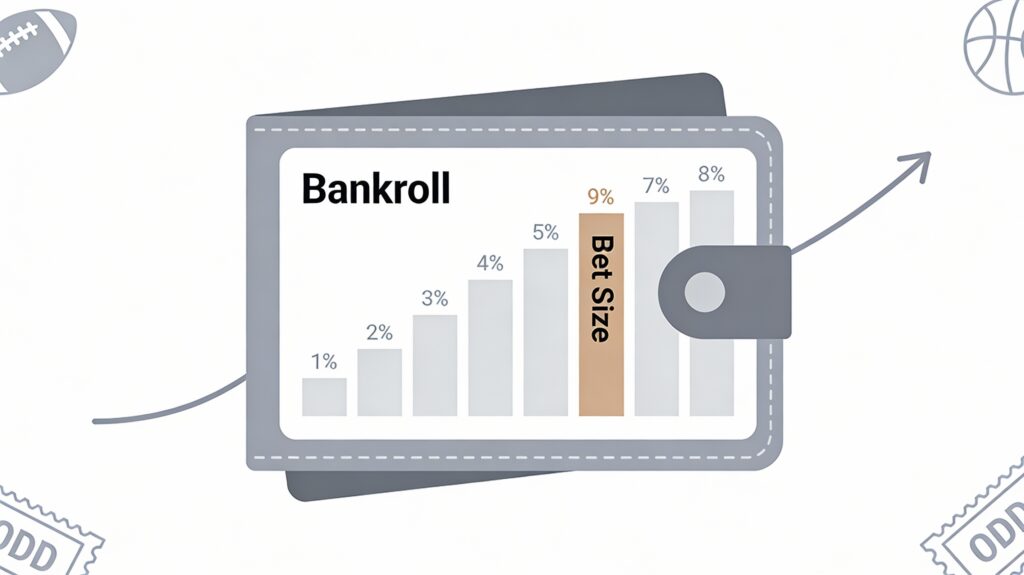
A unit is a standardized portion of your bankroll that you risk on a single bet. Many bettors risk between 1% and 5% of their bankroll per bet, depending on risk tolerance.
- Conservative approach: 1–2% per bet, minimizing risk during losing streaks
- Moderate approach: 2–3% per bet, balancing growth and risk
- Aggressive approach: 4–5% per bet, higher potential returns but higher risk
Example: With a $1,000 bankroll, 2% per bet equals $20 per wager.
3. Adjust Bet Sizes Dynamically
As your bankroll grows or shrinks, your unit size should adjust accordingly. This ensures consistent risk relative to current funds rather than fixed dollar amounts.
Example:
- Start with $1,000 bankroll at 2% per bet → $20 per bet
- After a winning streak, bankroll grows to $1,200 → 2% per bet = $24 per bet
- After a losing streak, bankroll drops to $800 → 2% per bet = $16 per bet
Dynamic adjustments prevent overexposure during losing streaks and optimize growth during winning streaks.
4. Avoid Chasing Losses
One of the most common mistakes is increasing bet sizes to recover losses. This emotional betting can quickly deplete a bankroll. Bankroll management requires discipline and patience, trusting the process rather than reacting impulsively.
5. Track Your Bets
Keeping a detailed record of every wager including odds, stake, sport, bet type, and outcome—is crucial. Tracking allows you to:
- Analyze performance across sports or bet types
- Identify profitable strategies
- Ensure compliance with your bankroll rules
Platforms like TheOver.ai provide automated bet tracking and analytics, making it easier to monitor bankroll usage, evaluate performance, and maintain discipline.
6. Diversify Bet Types
Managing bankroll also involves spreading risk across bet types and markets. Avoid betting your entire bankroll on a single high-risk prop bet or long shot. Instead:
- Mix spreads, totals, and moneyline bets
- Consider multiple sports or leagues if knowledgeable
- Limit exposure to volatile bets
Diversification reduces the likelihood of catastrophic loss and smooths variance over time. Because sportsbooks adjust odds dynamically, understanding how sportsbooks set betting lines helps bettors assess which markets carry higher risk for bankroll exposure.
7. Apply the Kelly Criterion (Optional Advanced Strategy)
The Kelly Criterion is a mathematical formula used to determine the optimal bet size based on your perceived edge and the odds. It is highly effective for maximizing growth while limiting risk, but requires accurate assessment of probability and value.
Formula:
Bet Size = Edge / (Odds in Decimal − 1) × Bankroll
While it can enhance growth, many bettors prefer flat percentage units for simplicity and safety.
Common Bankroll Management Mistakes
- Betting too much on a single wager – risking more than your unit size can quickly deplete your bankroll.
- Ignoring losing streaks – failing to adjust unit sizes when on a downward trend amplifies risk.
- Chasing losses – emotional overbetting often leads to larger losses.
- Poor record keeping – without tracking, it’s impossible to measure profitability or adjust strategy.
- Mixing funds – using daily life money for bets undermines discipline and clarity.
Example: Bankroll Management in Action
Suppose you have a $1,500 bankroll and decide on 2% per bet. That makes your unit $30.
- Bet 1: $30 on Team A at +120 → Wins $36 → Bankroll grows to $1,536
- Bet 2: $30 on Team B at -150 → Loses → Bankroll drops to $1,506
- Adjust unit size to 2% of new bankroll → $30.12 for next bet
By sticking to units, your bankroll withstands variance while compounding growth over time.
How TheOver.ai Supports Bankroll Management
TheOver.ai is designed to help bettors make data-driven decisions and maintain bankroll discipline. Its features include:
- Automatic tracking of bet sizes relative to bankroll
- Visualization of bankroll trends over time
- Alerts when bets exceed predefined unit sizes
- Analytical insights to identify profitable strategies
By combining bankroll discipline with an understanding of expected value (EV), bettors can focus on long-term decision quality rather than short-term results.
Conclusion
Bankroll management is the foundation of successful sports betting. No matter how accurate your picks are, without proper money management, even small losing streaks can derail your progress. Key principles include:
- Defining a dedicated bankroll
- Using percentage-based units per bet
- Adjusting bet sizes dynamically
- Avoiding chasing losses
- Diversifying bet types
- Tracking all wagers diligently
For bettors seeking long-term profitability, platforms like TheOver.ai provide essential tools to monitor bankroll, track bets, and maintain discipline. By combining disciplined bankroll management with sound betting strategy, bettors can reduce risk, handle variance, and maximize the chances of sustained success.