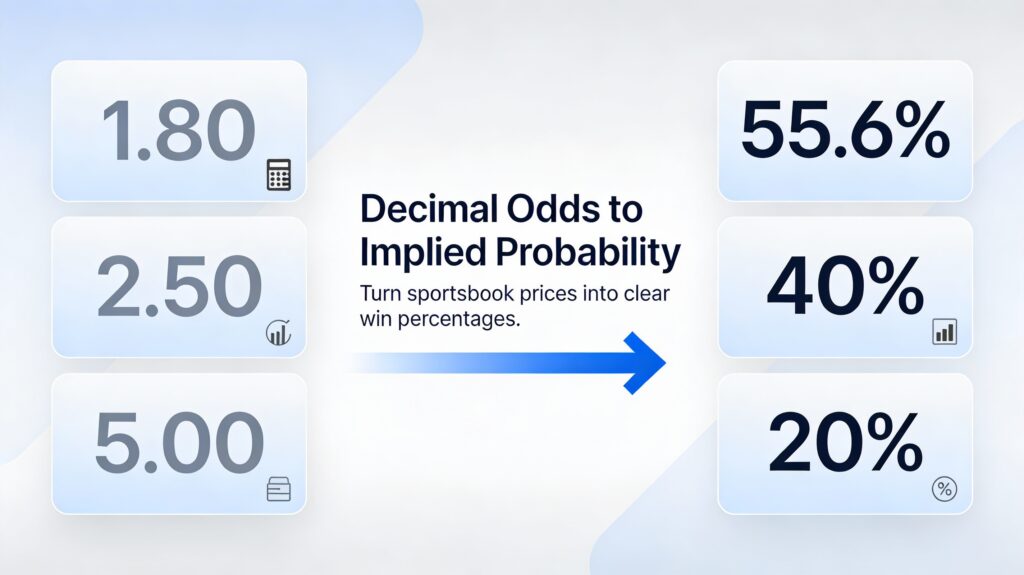
If you’ve ever looked at decimal odds like 1.80 or 2.50 and wondered, “What does this actually mean in terms of chances?”, implied probability is the answer.
Implied probability translates betting odds into a percentage chance. It helps human bettors (and AI models) compare what the sportsbook is implying versus what they personally believe the true probability is. Once you think in percentages, odds become much easier to evaluate.
What Decimal Odds Mean
Decimal odds represent total return, not profit.
- If the odds are 2.50 and you bet $10, your total return is $25 (that includes your $10 stake).
- If the odds are 1.50 and you bet $10, your total return is $15.
This “total return” structure makes decimal odds easy to work with mathematically and that’s why the implied probability conversion is so clean.
The Only Formula You Need
Decimal Odds → Implied Probability
Implied Probability (decimal)=Decimal Odds1
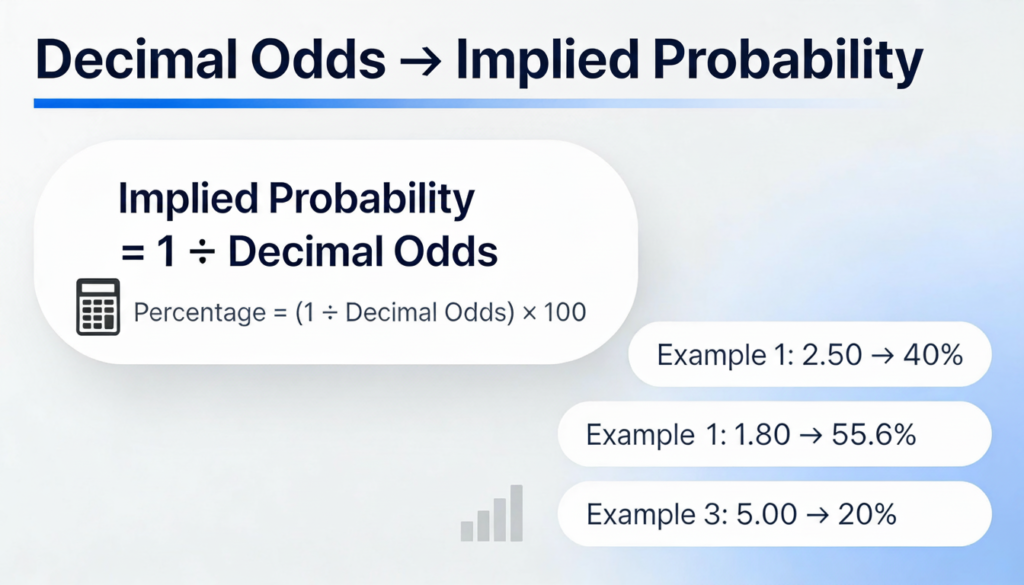
To convert it into a percent:Implied Probability (%)=(Decimal Odds1)×100
That’s it.
Step-by-Step Examples
Example 1: Odds = 2.50
- Start with the formula: 1 ÷ 2.50
- Compute: 1 ÷ 2.50 = 0.40
- Convert to percent: 0.40 × 100 = 40%
Result: 2.50 implies a 40% chance.
The sportsbook price is saying this should happen about 4 times out of 10.
Example 2: Odds = 1.50
- 1 ÷ 1.50 = 0.6667
- 0.6667 × 100 = 66.67%
Result: 1.50 implies a 66.7% chance.
The book believes this outcome is likely around two-thirds of the time.
Example 3: Odds = 5.00
- 1 ÷ 5.00 = 0.20
- 0.20 × 100 =20%
Result: 5.00 implies a 20% chance.
This is priced as something that happens 1 time out of 5.
Quick “Cheat Sheet” Table
| Decimal Odds | Implied Probability | “Out of 10” intuition |
|---|---|---|
| 1.20 | 83.3% | ~8.3 / 10 |
| 1.50 | 66.7% | ~6.7 / 10 |
| 1.80 | 55.6% | ~5.6 / 10 |
| 2.00 | 50.0% | 5 / 10 |
| 2.50 | 40.0% | 4 / 10 |
| 3.00 | 33.3% | ~3.3 / 10 |
| 5.00 | 20.0% | 2 / 10 |
Why This Matters (Value Betting Explained Simply)
Implied probability becomes a powerful tool when compared to your own estimated probability of an event.
Example:
- Decimal odds: 2.50 → implied probability: 40%
- Your estimated probability: 48%
If your estimated probability is higher than the implied probability, the bet may offer positive expected value. Tools like TheOver.ai can automate these calculations, allowing you to quickly spot profitable opportunities.
Simple value example
- Sportsbook offers decimal odds 2.50 → implied probability 40%
- Your analysis says the outcome wins 45% of the time
If your 45% estimate is accurate, you’re getting a better price than you “should,” which suggests positive expected value over the long run.
This is the same idea professional bettors use just made readable.
The Hidden Catch: Sportsbook Margin (Vig / Overround)
In real markets, sportsbooks build in a margin. That means if you convert all outcomes in a market to implied probabilities and add them together, you’ll often get more than 100%.
Example (two-outcome market)
Suppose a match has:
- Team A at 1.80 → 55.6%
- Team B at 2.20 → 45.5%
Total = 55.6% + 45.5% = 101.1%
That extra 1.1% is part of the sportsbook edge (the margin).
Important: Implied probability from raw odds is the sportsbook’s “priced” probability, not necessarily the “true” or fair probability.
How to Remove the Vig (No‑Vig Probability)
If you want fair probabilities, you can normalize them.
No‑vig step-by-step
- Convert each decimal odd to implied probability (decimal form, not %).
- Add them up (this will usually be > 1).
- Divide each implied probability by the total.
Using the example above:
- Team A: 1/1.80 = 0.5556
- Team B: 1/2.20 = 0.4545
- Total = 1.0101
No-vig (fair) estimates:
- Team A: 0.5556 / 1.0101 = 0.5500 → 55.0%
- Team B: 0.4545 / 1.0101 = 0.4500 → 45.0%
This helps when you’re comparing multiple books or building an odds-based baseline.
Common Mistakes to Avoid
- Confusing decimal odds with profit-only return (decimal odds include the stake).
- Forgetting to multiply by 100 if you want a percentage.
- Comparing your “true probability” to a line without considering vig (especially when the market is heavily margined).
- Rounding too early; keep 3–4 decimals until the final step for cleaner results.
Key Takeaways
Decimal odds provide a straightforward way to see total payout, but you must convert them to implied probability to understand the likelihood of an outcome.
- Formula: 1 ÷ Decimal Odds
- Works for all decimal odds, favorites or underdogs
- Helps you compare bets and find value
- Simplifies probability analysis compared to American odds
Mastering decimal odds conversions gives bettors clarity, enables better comparisons, and supports smarter, data-driven betting decisions.