Understanding how to convert American odds into implied probability is essential for bettors who want to make informed, data-driven decisions. American odds show potential payouts, but they do not directly reveal how likely an outcome is according to the sportsbook. Implied probability bridges that gap by translating odds into a percentage chance of winning.
What Is Implied Probability?
Implied probability represents the likelihood of an outcome occurring, as suggested by the odds set by a sportsbook. It is expressed as a percentage and reflects how often a result would need to happen for a bet to break even over time.
For example, if a bet has an implied probability of 50 percent, the sportsbook is effectively saying that outcome should occur 5 times out of 10 in the long run.
Why Converting American Odds Matters
American odds focus on risk and reward, not probability. While they tell you how much you can win or must risk, they do not clearly show how likely a bet is to succeed.
By converting American odds into implied probability, bettors can:
- Understand the sportsbook’s true expectation
- Compare odds across different markets
- Identify overvalued and undervalued bets
- Make more rational betting decisions
Without this conversion, bettors are guessing instead of analyzing.
Understanding American Odds Before Conversion
American odds come in two forms:
- Positive odds (+) indicate underdogs
- Negative odds (-) indicate favorites
Each type requires a different formula to calculate implied probability.
How to Convert Positive American Odds to Implied Probability
Positive American odds show how much profit you would earn on a $100 wager. These odds usually represent underdogs.
Formula for Positive Odds
Implied Probability =
100 ÷ (Odds + 100)
Example
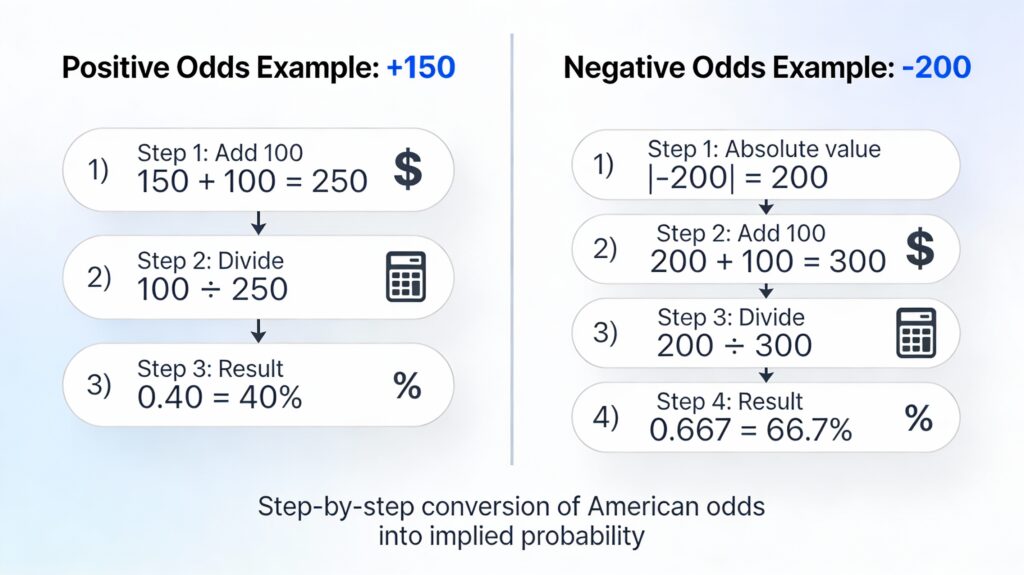
Odds: +150
Implied Probability =
100 ÷ (150 + 100)
100 ÷ 250
= 0.40 or 40%
This means the sportsbook believes this outcome has a 40 percent chance of winning.
How to Convert Negative American Odds to Implied Probability
Negative American odds show how much you must risk to win $100. These odds usually represent favorites.
Formula for Negative Odds
Implied Probability =
|Odds| ÷ (|Odds| + 100)
Example
Odds: -200
Implied Probability =
200 ÷ (200 + 100)
200 ÷ 300
= 0.6667 or 66.67%
This indicates the sportsbook believes this outcome will win about two-thirds of the time.
Why Two Different Formulas Are Required
American odds use two formulas because they communicate value differently depending on whether a team or player is favored or not.
Positive odds focus on potential profit, while negative odds focus on required risk. Each perspective requires a separate calculation to arrive at probability, which is why American odds are often considered more complex than other odds formats.
Comparing Implied Probability Across Bets
Once converted, implied probability allows you to compare bets objectively.
Example:
- Team A: -150 → 60% implied probability
- Team B: +130 → 43.5% implied probability
Even without looking at payouts, you can immediately see how the sportsbook rates each outcome.
Using Implied Probability to Find Value
Implied probability becomes powerful when compared to your own estimated probability.
Example:
- Sportsbook implied probability: 40%
- Your calculated probability: 48%
If you believe the outcome happens more often than the odds suggest, the bet may offer positive expected value.
This process is central to sharp betting and long-term profitability.
To find bets with positive expected value, compare the sportsbook’s implied probability with your own calculations. Platforms such as TheOver.ai provide automated, data-driven insights to make this easier.”
Common Mistakes When Converting American Odds
Many bettors make avoidable errors when calculating implied probability:
- Forgetting to change formulas based on positive or negative odds
- Ignoring the sportsbook’s built-in margin
- Confusing probability with payout size
- Estimating mentally without calculating precisely
Using the correct formula consistently prevents these mistakes.
Key Takeaways
American odds do not directly show probability, but they can be converted with simple formulas. Positive odds use one formula, negative odds use another, and both reveal how likely a sportsbook believes an outcome is to occur.
By mastering this conversion, bettors gain clarity, improve comparisons, and make smarter decisions grounded in probability rather than emotion.