Expected Value in betting helps you decide if a bet is smart. Many bettors only care about winning today. However, long-term success depends on making good decisions again and again.
Professional bettors use Expected Value to stay disciplined. Platforms offering AI-powered betting analysis also rely on EV. They focus on math, not emotion.
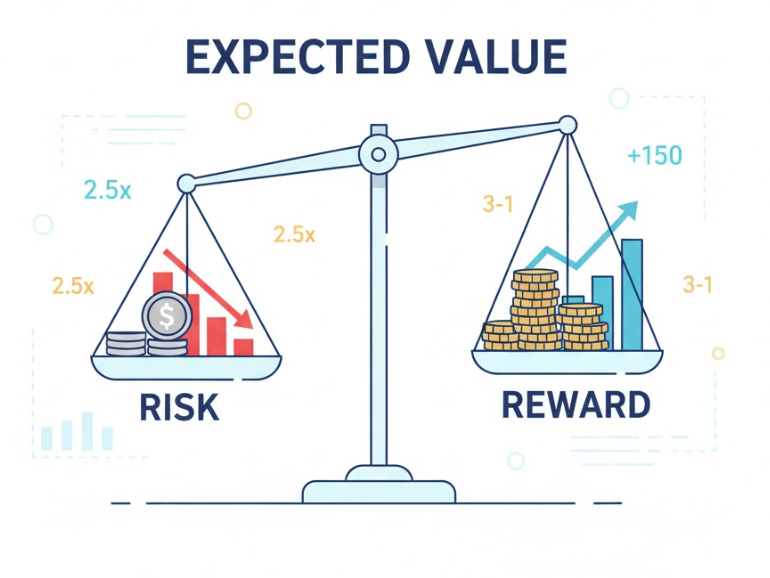
What Is Expected Value in Betting?
Expected Value, or EV, shows the average result of a bet over time. In simple words, it tells you if a bet is worth placing again and again.
A bet can be positive or negative. A positive EV bet makes money in the long run. A negative EV bet slowly causes losses.
EV does not predict one result. Instead, it measures decision quality. Because of this, smart bettors trust EV more than short-term results.
Expected Value Explained with a Simple Example
Now, let’s look at a simple daily-life example.
You play a game with these rules:
- A fair coin is flipped
- You win Rs. 200 for heads
- You lose Rs. 100 for tails
Each side has a 50% chance.
- 0.5 × 200 = +100
- 0.5 × –100 = –50
The Expected Value equals +50. As a result, you earn money over time even if you lose some rounds.
How Expected Value Works in Sports Betting
Expected Value (EV) in sports betting works by comparing probability with odds. The goal is simple: find bets where the potential reward is greater than the actual risk.
First, you estimate the true chance of an outcome. For example, you may believe a team has a 60% chance of winning based on form, matchups, and data.
Next, you look at the bookmaker’s odds. Odds always imply a probability. If the odds suggest the team has only a 45% chance to win, a gap appears.
This gap creates value.
When your estimated probability is higher than the probability implied by the odds, the bet has positive Expected Value. When it is lower, the bet has negative Expected Value.
Because of this, EV is not about predicting winners. Even strong EV bets lose sometimes. However, when you place positive EV bets repeatedly, profits build over time.
Why Expected Value Matters More Than Winning
Many bettors focus only on winning individual bets, but this approach is misleading. Expected Value (EV) measures the quality of the decision, not the short-term outcome. A single win doesn’t guarantee a good bet, and a single loss doesn’t mean the bet was bad.
Short-term results can be misleading
Even bets with positive EV can lose occasionally due to luck or variance. Conversely, negative EV bets might win sometimes, but they lose money over time.
Long-term profitability
The true power of EV lies in repetition. Placing positive EV bets consistently leads to steady profits, while relying on wins alone can result in poor decisions and losses over time.
Discipline over emotions
By focusing on EV, bettors avoid chasing losses or overreacting to wins. This disciplined approach ensures that decisions are based on data and probability rather than emotion, which is why professional bettors and AI-driven systems prioritize EV above short-term outcomes.
How AI Uses Expected Value
AI uses Expected Value (EV) to decide whether a bet is worth taking, not whether it will win today. Instead of relying on intuition or emotion, AI evaluates decisions using data and probability.
First, AI analyzes large amounts of historical data. This includes past match results, team performance, player statistics, and market odds. From this data, the AI estimates the true probability of each possible outcome.
Next, AI compares this estimated probability with the probability implied by bookmaker odds. When the AI believes an outcome is more likely than the odds suggest, it identifies a positive Expected Value opportunity.
Because of this approach, AI focuses on:
- Decision quality rather than short-term results
- Long-term profitability instead of single wins
- Consistency over emotion
AI also recalculates Expected Value as new information appears. For example, changes in odds, injuries, or line movement immediately update the EV calculation. As a result, AI can adapt faster than human bettors.
Most importantly, AI applies the same EV logic to every decision. It does not chase losses, overreact to wins, or follow public opinion. This disciplined, data-driven use of Expected Value is why AI-based betting systems outperform intuition-based betting over time.
Platforms like TheOver.ai study past results, odds movement, and patterns. Then, they calculate Expected Value to find smart betting choices.
This same logic appears in how AI predicts sports outcomes .

Final Thoughts
Expected Value in betting changes how you judge success. Instead of chasing wins, it rewards smart choices.
Luck affects single bets. EV controls long-term results. For serious bettors, understanding EV is essential.